
In a world that increasingly relies on technology and scientific discoveries, it’s easy to forget what’s happening inside us. We live in an age where science provides answers to questions that seemed impossible to solve just a hundred years ago. We are getting better at understanding how the universe works at a quantum level, we can observe distant galaxies, and we are uncovering the mechanisms that govern our bodies. But is that enough to understand ourselves?
Spirituality, especially in a non-religious sense, offers something science can’t—introspection, self-knowledge, and answers to questions about the meaning of life. This isn’t about believing in dogmas or rituals, but rather a journey inward that allows us to discover who we really are and how to find harmony in a world full of chaos.
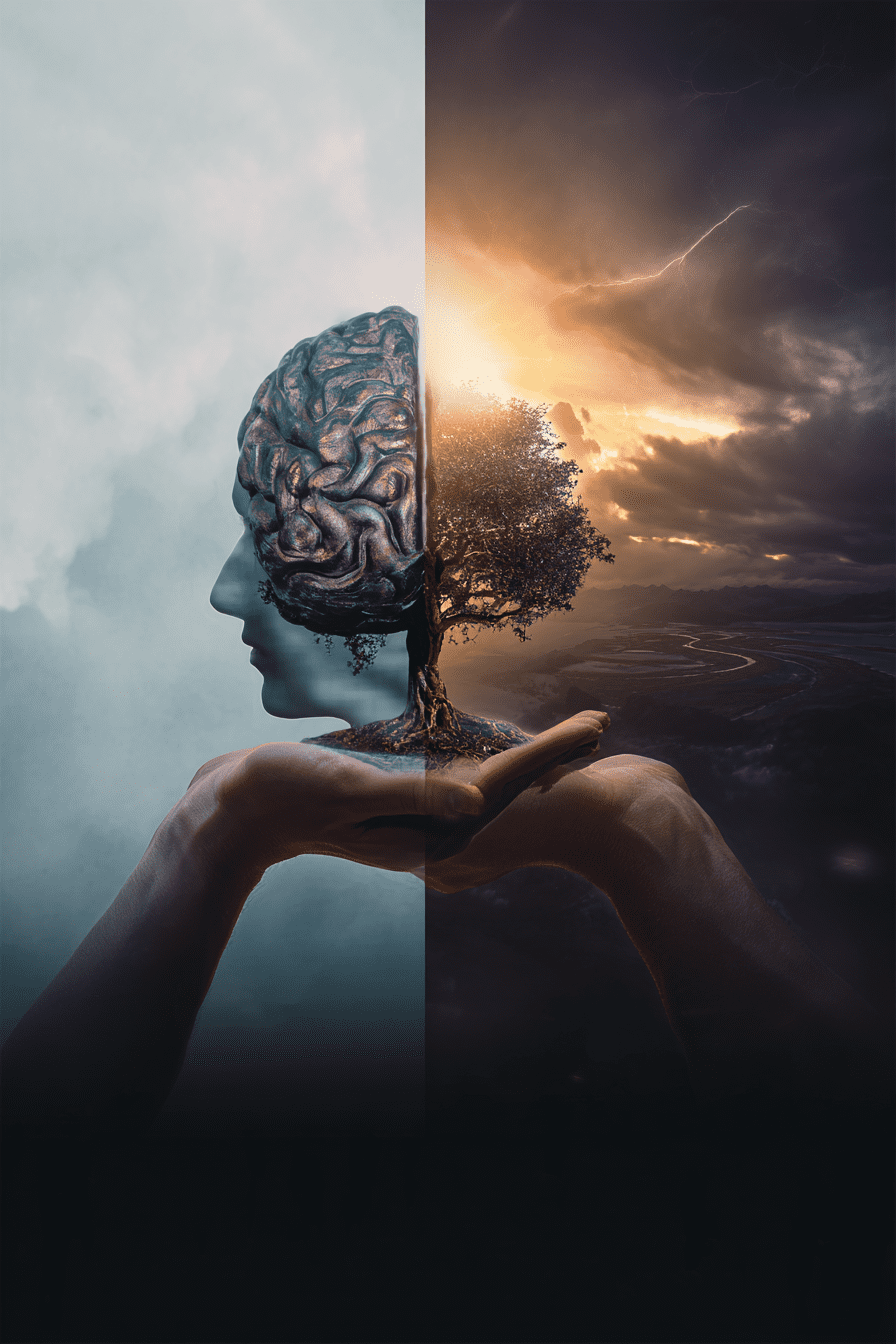
In this article, I want to show that science and spirituality are not in conflict. On the contrary, they are like two threads of the same fabric, intertwining and complementing each other. Science explores the external mechanisms of the universe that are common to all of us, while spirituality explores the internal mechanisms of our consciousness, which are unique to each of us. Both paths of knowing are essential if we want to fully understand both the world and ourselves.
The inspiration for this text was the book “Quantechism, or a Cage for People” by Andrzej Dragan. As a brilliant physicist, Dragan explains complex concepts of quantum physics and relativity in an accessible way, but at the same time, he doesn’t hide his criticism of religion and dogmas. For me, it’s quite the opposite, because his metaphor of pigs in a cage, who don’t think about the mechanism that delivers their food, is an excellent starting point for reflecting on how science and spirituality can complement each other.
Science Looks Outward, Spirituality Looks Inward
Science and spirituality are often seen as opposites, but they are actually complementary. Science is the quest to understand the external world—the laws of physics, the structure of the universe, the mechanisms of life. It aims to uncover truths that are universal, measurable, and repeatable. Spirituality, on the other hand, is the exploration of the inner world—our thoughts, emotions, consciousness, and sense of purpose. It is deeply personal, subjective, and unique to each individual.
Science: Exploring Our Shared Universe
Science thrives on objectivity. It’s a methodical process of observation, experimentation, and analysis that allows us to discover the fundamental principles governing the universe. From the laws of gravity to the mysteries of quantum mechanics, science provides a framework for understanding “how” existence works.
Take the groundbreaking work of physicists like Albert Einstein and Niels Bohr. Einstein’s theory of relativity changed our understanding of space and time, while Bohr’s contributions to quantum mechanics revealed the strange and counterintuitive behavior of particles at the smallest scales. These discoveries not only expanded our knowledge but also gave us the tools to create technologies that shape our daily lives—from smartphones to GPS systems.
However, science, for all its brilliance, has its limits. It can tell us how the universe works, but it can’t answer why it exists or what it means for us as individuals. It can measure brain activity during meditation, but it can’t fully capture the subjective experience of inner peace or transcendence. This is where spirituality comes in.
A Quick Detour on the Objectivity of Science
I need to clarify something here. Although I believe science strives for objectivity, it’s worth remembering that it is limited by our human perspective. What we consider “objective” is actually an interpretation of reality seen through the lens of our senses, tools, and language. For example, our studies of the universe are based on electromagnetic waves that we can detect and interpret, but would another form of intelligence, with different senses or technologies, perceive the same phenomena in the same way? Perhaps what is an “objective truth” for us would be just a subjective interpretation for another civilization.
Similarly, in quantum mechanics, the observer effect shows that the very act of observation can influence the outcome of an experiment. This suggests that the objectivity of science has its limits and is inextricably linked to our way of perceiving reality. Science, though incredibly effective at studying the external world, is in a sense subjective to us as humanity—seen through our eyes and understood by our minds.
Spirituality: The Journey Within
Spirituality, especially in its non-religious form, is about turning inward. It’s a process of self-discovery, of asking questions like: Who am I? What is my purpose? How can I find meaning in my life? Unlike science, which seeks universal truths, spirituality is deeply personal. It’s about understanding your own consciousness, your own emotions, and your own place in the world.
Practices like meditation, mindfulness, and journaling are tools of spirituality that help us explore our inner lives. They allow us to observe our thoughts without judgment, connect with our emotions, and cultivate a sense of presence and awareness. These practices are not about following dogmas or external authorities; they are about discovering your own truth.
For example, meditation has been shown to reduce stress, improve focus, and even change the structure of the brain. But beyond its measurable benefits, it offers something even more profound: insight into the nature of consciousness itself. It allows us to step back from the noise of daily life and connect with something deeper—whether you call it your true self, your soul, or simply a state of being.
The Intersection of Science and Spirituality
Although science and spirituality may seem to operate in different realms, they are not mutually exclusive. In fact, they often intersect in fascinating ways. Neuroscience has begun to study the effects of spiritual practices, like meditation, on the brain. Studies have shown that regular meditation can increase gray matter density in areas related to learning, memory, and emotional regulation. This is a perfect example of how science can validate and deepen our understanding of spiritual experiences.
Similarly, quantum physics has opened up questions that border on philosophy and spirituality. Concepts like quantum entanglement and the observer effect challenge our traditional notions of reality and suggest that the universe is far more interconnected and mysterious than we once thought. These discoveries invite us to think not only about the mechanics of the universe but also about our place within it.
Challenging Dogma: The Common Ground of Science and Spirituality
At first glance, science and spirituality might seem like distant worlds. Science is often seen as the domain of logic, evidence, and objectivity, while spirituality is associated with intuition, subjectivity, and personal experience. However, both fields share a deep and often overlooked trait: they challenge dogma and push the boundaries of what we know.
Science: Breaking Free from the Chains of Certainty
Science thrives on questioning the status quo. Its foundation is skepticism and a willingness to challenge established ideas. Every great scientific breakthrough—from Copernicus’s heliocentric model to Darwin’s theory of evolution—emerged from a refusal to accept the prevailing dogmas of the time.
Consider quantum mechanics. When physicists like Max Planck and Albert Einstein began to study the behavior of particles at the quantum level, they encountered phenomena that defied classical physics. The idea that particles could exist in multiple states at once or that the act of observation could affect reality was not just counterintuitive—it was revolutionary. These discoveries forced scientists to rethink the very nature of reality and accept that the universe operates in ways far stranger than we can easily comprehend.
The power of science lies in its ability to adapt and evolve. It does not cling to dogmas; instead, it seeks to overthrow them. This relentless pursuit of truth, even when it challenges deeply held beliefs, is what makes science such a powerful tool for understanding the world.
Spirituality: Questioning Inner Dogmas
While science challenges external dogmas, spirituality focuses on the internal ones—the beliefs, assumptions, and narratives we hold about ourselves and the world. These inner dogmas can be just as limiting as external ones, shaping how we see ourselves and our place in the universe.
Many of us carry unexamined beliefs about our own worth, potential, or the nature of happiness. Spirituality invites us to question these beliefs and explore what lies beyond them. Practices like meditation or self-inquiry encourage us to observe our thoughts and emotions without judgment, to identify the stories we tell ourselves, and to let go of those that no longer serve us.
This process of self-exploration is not about adopting new dogmas or rigid belief systems. Instead, it is about cultivating openness and curiosity—a willingness to be with uncertainty and embrace the mystery of existence. In this way, spirituality mirrors the scientific method: both are journeys of discovery that require us to ask questions, explore, and remain humble in the face of the unknown.
Andrzej Dragan’s “Pigs in a Cage” Metaphor
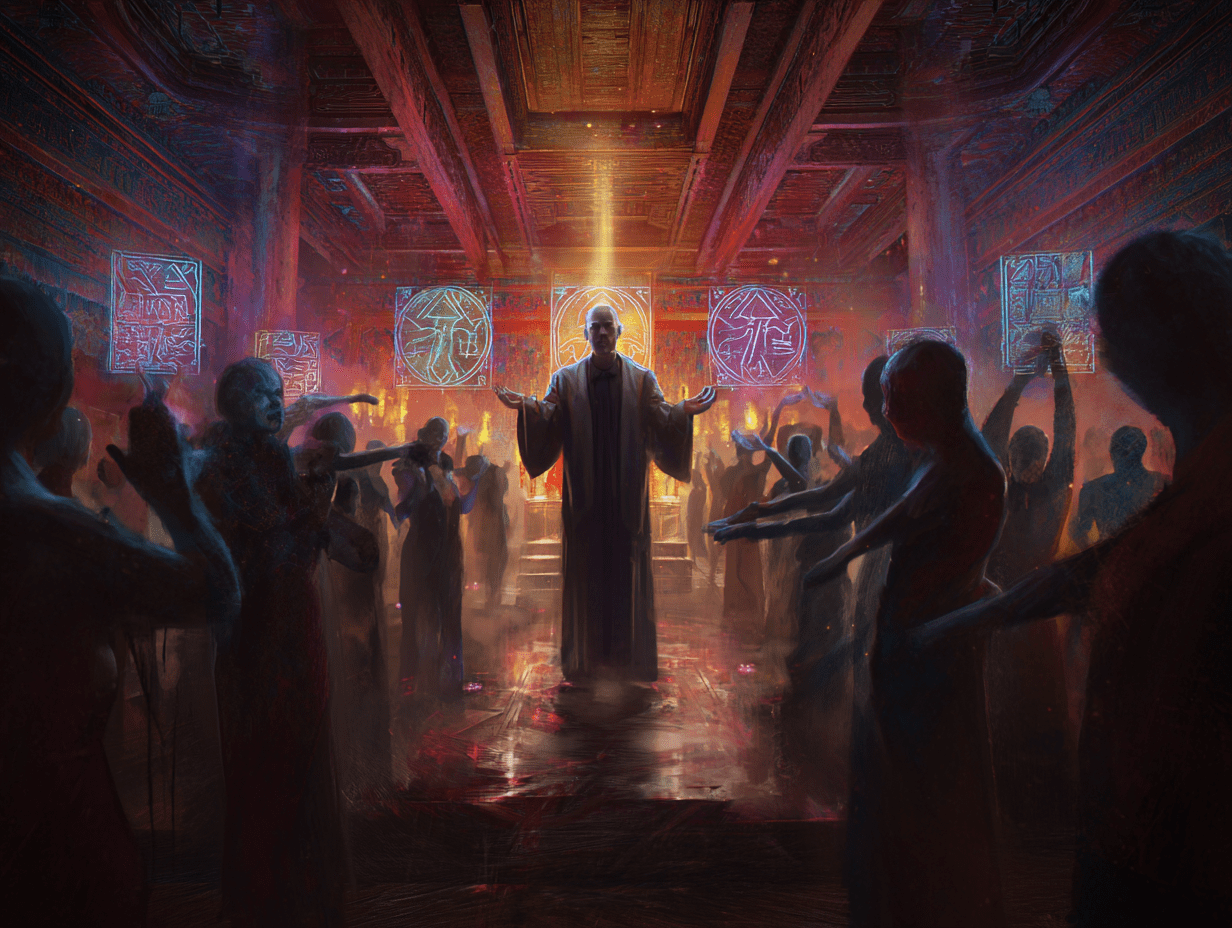
In his book “Quantechizm, or a Cage for People,” Andrzej Dragan uses a powerful metaphor of a cage to illustrate people’s approach to reality—especially in the context of religion, science, and spirituality. His argument begins with an image of pigs in a cage. One pig presses a button, and food appears, but another, more dominant pig eats the food. The small, discouraged pig eventually stops pressing the button. The large pig takes over, and the small one can finally eat before the large one runs back. Both get to eat, but that’s not the point. Neither one wonders how the food delivery mechanism actually works. They accept the conditions without curiosity—they are not interested in where the food comes from or who is behind the mechanism.
Dragan uses this allegory to criticize people who take things on faith, as in religion, without trying to investigate the “cage,” or the mechanisms they live within. This refers to religious dogmas—according to Dragan, religion sets limits and blocks inquiry by relying on ready-made answers and strict rules. Religious people use the achievements of science, physics, and technology (phones, computers, cars) without analyzing how they work or being interested in the principles behind their operation. Meanwhile, science—and especially physics—constantly explores these boundaries, challenges dogmas, and interprets the world through verifiable principles, gradually pushing religious faith out of more and more areas of knowledge.
But here—contrary to what Dragan suggests—lies the important role of spirituality that I want to emphasize. While religion indeed confines itself to dogmas, and science boldly investigates the “cage” from a technical and theoretical standpoint, (non-religious) spirituality is not a passive acceptance of things on faith. Quite the contrary—it is a process of self-discovery, a search for meaning, and a questioning of one’s own internal limitations. Spirituality doesn’t ask “how does the cage work?” but rather, “how can I live meaningfully in this cage?”, “what can this cage teach me?”, “how can I find values that will help me live more consciously and creatively within these limits?”. It is responsible for expanding horizons internally and provides tools for seeking universal truths and values, developing intuition, creativity, or self-acceptance.
Dragan accurately shows that science investigates “how” the world-cage works and removes successive veils of ignorance that religion has masked with dogmas for centuries. But true human development also requires spiritual effort: discovering what is worth believing in, what values to cultivate, how to live in this “cage” in harmony with oneself. Spirituality doesn’t close but opens—and allows you to ask yourself: how can I live a fuller, more meaningful life, closer to my own truth, even while remaining within the boundaries that science has not yet managed to explain?
This is where science and spirituality can truly complement each other: physics and science help us understand the world from the outside, while spirituality inspires us to work on ourselves, develop values, cultivate intuition and creativity—and be ready to ask questions, even if we don’t always get immediate answers.
Examples of Scientists Building Bridges
Many contemporary scientists and thinkers actively show that science and spirituality can coexist and even complement each other. Carlo Rovelli, a theoretical physicist, often writes about the philosophical implications of quantum mechanics and the nature of time, combining scientific rigor with a sense of wonder and curiosity. Michio Kaku, another prominent physicist, explores the frontiers of science and the questions it raises about consciousness, free will, and the nature of existence.
A special place in this dialogue is held by Amit Goswami—a professor of quantum physics and a popularizer of the concept of consciousness as the fundamental principle of the universe. Goswami consistently emphasizes that quantum physics opens the door to new interpretations of reality where science and spirituality meet and inspire each other.
On the Polish front, it is worth mentioning Fr. Prof. Michał Heller, winner of the prestigious Templeton Prize in 2008—awarded for building bridges between science and spirituality. For years, Heller has combined scientific and philosophical reflection with deep spirituality, showing that the search for meaning and the understanding of the universe do not have to be mutually exclusive but can complement each other.
This group also includes Federico Faggin—a distinguished physicist, inventor (creator of the first microprocessor), and philosopher of science, who has been exploring the topic of consciousness and its connections to the nature of reality for years. In his publications and speeches, Faggin argues that science and the spiritual sphere are inextricably linked, and true understanding of ourselves and the universe requires openness on both of these planes.
It is also worth noting Carl Jung—an eminent psychologist who built a bridge between science and spirituality through his research on the collective unconscious, archetypes, and synchronicity. Jung was convinced that the deep layers of the human psyche are transpersonal and connect us to a universal source of meaning, and that spiritual experiences and symbols that appear in dreams or cultures have common, archetypal roots. The phenomenon of synchronicity, which he described, concerned “meaningful coincidences” independent of causality, highlighting the spiritual dimension of human experience. In a 1959 BBC interview, Jung famously stated, “I don’t need to believe in God; I know,” reflecting his view of God as a profound, mysterious force rooted in personal experience rather than traditional dogma. Jung proved that an open, holistic psychology can be a bridge between the world of science and the spiritual dimension, inspiring both scientists and seekers of meaning to this day.
Even Albert Einstein, one of the greatest scientific minds in history, famously said: “Science without religion is lame, religion without science is blind.” Although Einstein’s use of the word “religion” was more aligned with a sense of cosmic awe than organized faith, his sentiment underscores the idea that science and spirituality are not mutually exclusive but complementary.
A Holistic Approach to Understanding
By building a bridge between the external and the internal, science and spirituality offer a more holistic approach to understanding existence. Science provides the tools to explore the physical world, while spirituality helps us navigate the emotional and existential dimensions of life. Together, they remind us that we are not just observers of the universe but active participants in its unfolding.
Conclusion: Why We Need Both
Science and spirituality are often presented as opposing forces, but this dichotomy is both unnecessary and limiting. Instead of viewing them as adversaries, we can see them as complementary paths to understanding—two lenses through which we can explore the mysteries of existence. Together, they provide a fuller, richer picture of what it means to be human.
The beauty of combining science and spirituality lies in their shared spirit of inquiry. Both challenge dogmas, whether external or internal. Both push us to question our assumptions and expand our horizons. And both remind us that the journey of understanding—whether directed outward toward the cosmos or inward toward the self—is never complete. There is always more to learn, more to discover, and more to experience.
So the next time you gaze up at the stars or sit in quiet meditation, remember that these two acts—one scientific, one spiritual—are not so different after all. They are both expressions of the same fundamental human desire: the desire to understand, to connect, and to find our place in the vast and wonderful universe.
If my writing has inspired or helped you, I would be grateful for your support.
Need support yourself? Discover how I can help you.
AI Disclosure
I see my thoughts as the essence, much like the soul, and AI helps me give them form. It supports me with research, translation, and organizing ideas, but every perspective is my own. Curious how I use AI? Read more here.