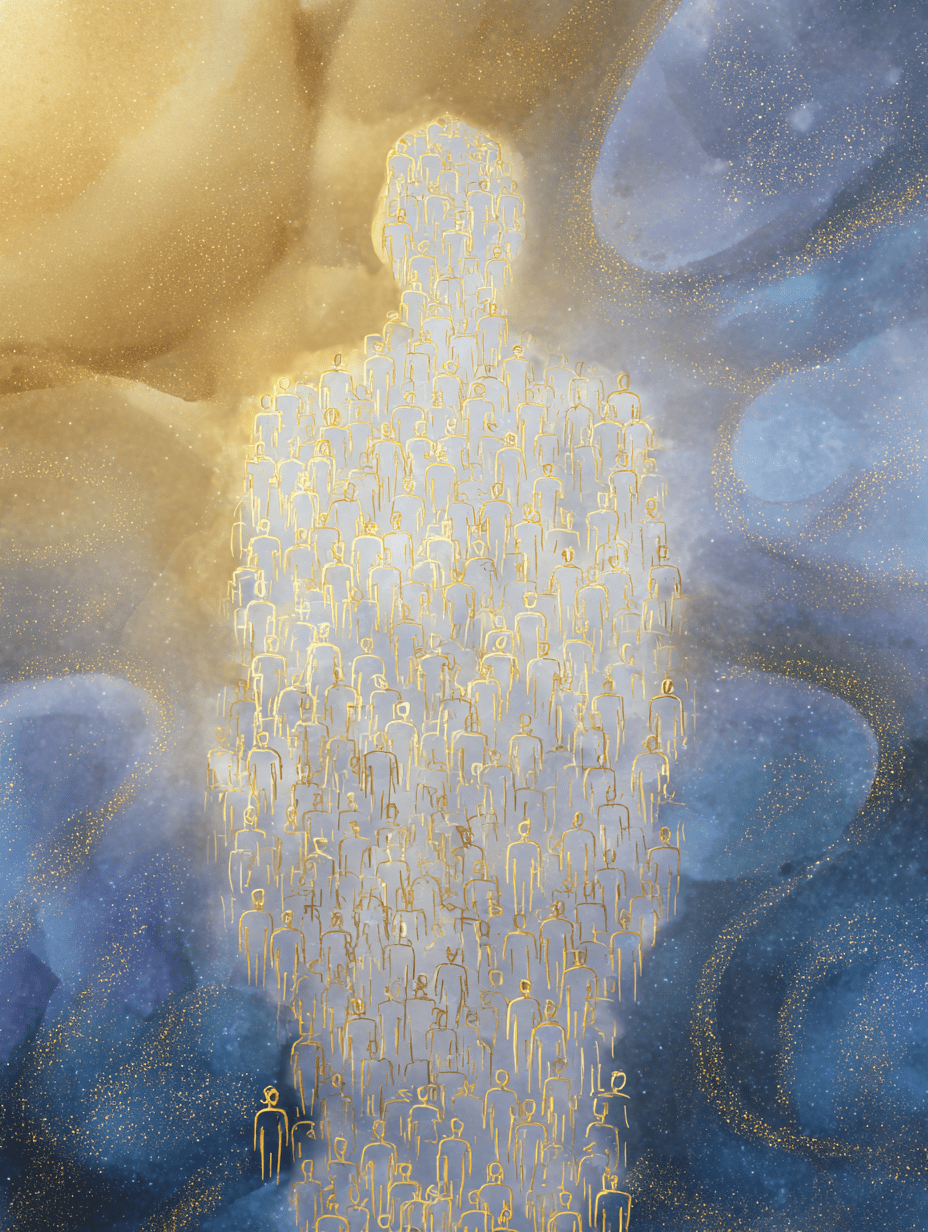

In a world consumed by noise and the relentless pursuit of personal success, there are certain figures who remind us of a different, deeper path—the path of selfless service. One such figure is Mother Teresa of Calcutta, a petite woman with a gigantic heart who became a global symbol of compassion in action. Her life, dedicated to the poorest of the poor, stands as a powerful testament to how spirituality can transform into tangible help and change the destiny of thousands.
She once said, “Not all of us can do great things. But we can do small things with great love.” This simple yet incredibly profound sentence captures the essence of her mission. In today’s “Inspiring Souls” article, we will look at her life not just as a historical figure, but as a teacher whose lessons are perhaps more relevant today than ever. We’ll explore what her stance—much like Nelson Mandela’s forgiveness or Mahatma Gandhi’s nonviolence—tells us about the power of humility, inner transformation, and finding meaning in giving oneself to others.
I invite you on a journey in the footsteps of a woman who showed the world that true greatness is born in humility and love.
The Life and Mission of Mother Teresa
Every great journey begins with a single step, and for Mother Teresa, that step was into the unknown, driven by a deep inner calling. Born Anjezë Gonxhe Bojaxhiu in Skopje, she felt from a young age that her life was meant to be dedicated to God and humanity. At just 18, she left her family home to join the Sisters of Loreto in Ireland. From there, as Sister Teresa, she set off for India to teach at a school in Calcutta.
For years, while teaching, she witnessed the extreme poverty surrounding her from behind the convent walls. It was there, amidst the chaos of Indian streets, that she heard what she called a call within a call. It was an internal command to leave the safety of the convent and go serve the poorest of the poor—those living and dying on the streets. This decision required extraordinary courage. It was the moment when her deep faith became the driving force for real action in a world full of suffering.
Mother Teresa’s spiritual strength was rooted in her unwavering faith and daily practices of prayer and reflection. She began each day with Mass and spent hours in silent adoration before the Blessed Sacrament. This deep connection to God was her source of energy and resilience, especially during moments of doubt and hardship. She often said, “Prayer is not asking. Prayer is putting oneself in the hands of God, at His disposition, and listening to His voice in the depth of our hearts.”
Her ability to see Christ in the faces of the poor and suffering was a direct result of this profound spiritual discipline.
In 1950, with little support but immense trust, she founded the Missionaries of Charity. Its mission was simple and radical: to serve “the hungry, the naked, the homeless, the crippled, the blind, the lepers, all those people who feel unwanted, unloved, uncared for throughout society.” It started with a small school in the slums, followed by the first home for the dying, where people rejected by everyone could pass away with dignity, surrounded by love.
The work of the Missionaries of Charity quickly expanded beyond India’s borders, reaching the farthest corners of the globe. Today, they run hospices, homes for people with HIV/AIDS, orphanages, and soup kitchens worldwide. Mother Teresa’s story shows that spirituality is not just inner contemplation but, above all, an active response to the needs of another human being. Her life is proof that one person, armed with faith and compassion, can start a wave of goodness that changes thousands of lives.
Lessons in Compassion and Humility
Mother Teresa’s life is not just a story about helping; it is a profound lesson on how to help. Her philosophy rested on two pillars: compassion that translates into action, and humility that gives that action meaning. It was these values that made her work so revolutionary.
Compassion, in her understanding, was not merely a fleeting feeling of pity. It was a conscious decision to see dignity and inner light in every human being, even the most downtrodden. When she lifted a dying person from the street, she didn’t just see an anonymous victim of poverty. She saw Christ in “the distressing disguise,” as she often put it. This perspective changes everything. It teaches that true help isn’t about tossing a coin from a position of superiority, but meeting another human being on equal ground—heart to heart. This approach echoes the teachings of Rumi, who sought the divine in the everyday and unity in all existence. Mother Teresa found that divinity in the eyes of those the world had written off.
Her famous words, “If you judge people, you have no time to love them,” are a powerful call to abandon our prejudices and judgments. In a world that so easily labels and divides, her stance teaches that love is an act of will, not an emotional impulse. It is a choice to serve, listen, and be present, even when it is difficult and uncomfortable.
The second pillar was humility. Mother Teresa lived in extreme simplicity, rejecting material goods. Her order was based on the principle that the sisters should live exactly like the people they served. This stance wasn’t an end in itself, but a tool. It protected against the pride that often accompanies charitable work. It was a reminder that we are not saviors, but servants. It was humility that allowed her to perform the hardest tasks—cleaning wounds, feeding the helpless, holding the hands of the dying—not as a sacrifice, but as a privilege.
These lessons are incredibly relevant for each of us, especially when we are going through our own crises or feel powerless in the face of the immense suffering in the world. Mother Teresa teaches us that we don’t have to change the whole world. It is enough to change the world for one person. We can start with small things, but do them with great love: from a smile to a stranger, to listening to a friend in need, to volunteering our time. Each of these small gestures is an echo of her mission and proof that compassion in action has the power to transform—both the one receiving help and the one giving it.
Research supports the transformative power of compassion, not only for those who receive it but also for those who practice it. A study published in the journal Psychological Science found that acts of kindness and compassion can significantly improve mental well-being and reduce stress. This aligns with Mother Teresa’s belief that “the fruit of love is service, which is compassion in action.” By serving others, we not only help them but also find healing and purpose in our own lives.
Criticism and Controversies
No figure with such a massive impact on the world is free from criticism, and Mother Teresa is no exception. Discussing her legacy requires honesty, and that means looking at the controversies that have arisen around her work. This is an important part of reflection because it allows us to understand how complicated it is to implement lofty ideals in an imperfect world.
The main accusations concerned the conditions in her hospices and homes for the sick. Critics, including doctors and former volunteers, pointed to insufficient medical care, a lack of painkillers, and the reuse of needles. From the perspective of Western medicine, such standards were unacceptable. Instead of professional medical facilities, her homes resembled places where people could die with dignity, surrounded by love, but not necessarily treated according to the latest medical knowledge.
Another flashpoint was her theology of suffering. Mother Teresa believed that suffering brings one closer to Christ and has redemptive value. She told the sick that their pain was “a kiss from Jesus.” For many, this approach was hard to accept, especially when coupled with a reluctance to administer strong painkillers. This raised the question: did the glorification of suffering contradict the mission of alleviating it?
Controversies also arose regarding the order’s finances—huge sums of money donated that were not always spent on improving conditions in the hospices.
Looking at these accusations is not meant to undermine her intentions but to prompt deeper reflection. Was her mission about professional medical care, or about providing spiritual solace and human presence to those the system had completely rejected? Perhaps her goal wasn’t to create hospitals, but homes where love was more important than medicine. This reminds us of Viktor Frankl’s lessons, who, in the unimaginable chaos of a concentration camp, sought meaning not in changing external circumstances, but in his internal attitude toward them.
Mother Teresa’s story teaches us that even the noblest intentions can meet with criticism and be realized imperfectly. Instead of looking for flawless heroes, perhaps we should draw inspiration from people who, despite their own limitations and mistakes, had the courage to act. Her life presents us with a difficult question: is it better to do something imperfectly, or to do nothing at all?
The Legacy of Mother Teresa
Mother Teresa’s legacy isn’t locked away in monuments or history books. It is a living force that still pulses around the world, inspiring millions to act. Her influence reaches far beyond the walls of Calcutta’s hospices, becoming a universal symbol that one person, armed with faith and love, can be the spark for global change.
The most tangible proof of her legacy is the continuation of her mission by the Missionaries of Charity. Today, thousands of sisters in their distinctive white and blue saris serve in over 130 countries, running homes for the dying, orphanages, soup kitchens, and centers for AIDS patients. Every day, they embody her philosophy of small things done with great love, going where others are afraid to look. Their work is a quiet but powerful testament that Mother Teresa’s ideals did not die with her.
However, her legacy is more than just an institution. It is an idea planted in human hearts that compassion has the power to transform. Her life has inspired countless local initiatives, NGOs, and volunteer movements around the globe. From small parish groups organizing help for the homeless to global humanitarian organizations—in each of them, you can see an echo of her call to service. Examples include modern palliative care movements, which, while often using modern medical methods, draw inspiration from her emphasis on dignity and human presence in the final moments of life.
Mother Teresa’s story, like that of Malala Yousafzai fighting for education, shows that you don’t need power or wealth to change the world. You just need the courage to respond to the needs of another human being. Her legacy is a call to each of us. It reminds us that in the face of our own crisis or helplessness regarding world suffering, the most effective cure is often turning toward others. Service, even the smallest kind, gives our life meaning and perspective. Mother Teresa’s legacy is not a relic of the past, but a compass that still points the way—the path of love, humility, and selfless service.
According to a report by the Missionaries of Charity, the organization now operates in over 130 countries, providing care to millions of people annually. Their work includes running homes for the dying, orphanages, and centers for the homeless, embodying Mother Teresa’s vision of love in action. This global reach demonstrates the enduring impact of her mission and the timeless relevance of her values.
Practical Lessons for You
Mother Teresa’s life might seem monumental, and her sacrifice almost unattainable. It’s easy to think: “What can I, an ordinary person, do compared to her?” Yet, the greatest strength of her message lies in its simplicity. She didn’t call us to abandon everything and move to Calcutta, but to find our own Calcutta right where we are—in our homes, workplaces, and communities. Here are a few practical lessons you can implement today.
1. Start with small things, but with great love.
This is the quintessence of Mother Teresa’s philosophy. You don’t have to solve global problems to change the world. Start with your immediate surroundings. It could be a smile directed at a neighbor, patiently listening to a friend going through a hard time, or helping an elderly person with groceries. Each of these small gestures, done with genuine care, has immense value. Ask yourself: “What is one small thing I can do today for someone with great love?”
2. Make time for presence.
In today’s busy world, one of the most precious gifts we can offer is our full attention. When talking to loved ones, put down the phone. When spending time with children, be with them truly, not just nearby. Practicing mindful presence is a form of compassion. You show the other person: “You are important to me. I see you and I hear you.”
3. Discover your “Calcutta.”
Mother Teresa served the poorest on the streets. Your “Calcutta” might be closer than you think. It could be the loneliness of a colleague, financial difficulties in the family, or a local animal shelter needing volunteers. Think about where in your environment there is suffering or a need you can respond to. It could be an hour a week dedicated to volunteering or supporting a local fundraiser. Every action matters.
4. Practice humility in daily life.
Humility isn’t about putting yourself down, but about a realistic view of oneself and a readiness to serve others without expecting applause. How to do this? Give up your seat in line. Admit when you’re wrong. Thank someone whose work often goes unnoticed, like a cleaner or a bus driver. These simple acts teach us that the world doesn’t revolve around us and help build authentic relationships.
Living in the spirit of Mother Teresa doesn’t require heroic deeds. It requires an open heart and a readiness to act. Research shows that acts of kindness can increase happiness, improve mental health, and even promote physical well-being. Start today, with one small thing. As she herself said: “Let no one ever come to you without leaving better and happier.” This call is within reach for every one of us.
Reflection Questions:
- What small act of kindness can you do today to make someone feel seen and valued?
- How can you create moments of presence and connection in your daily interactions?
- Where is your “Calcutta”? What need in your community can you respond to with compassion and humility?
Conclusion
Though her life ended decades ago, Mother Teresa remains a bright guiding point in a world that often loses itself in the chaos of indifference. Her story is not just a tale of a nun from Calcutta, but universal proof that compassion is the most powerful force we possess. It reminds us that spirituality doesn’t end with meditation or prayer but finds its full expression in meeting another human being—especially the wounded and rejected one.
In moments of our own life crises, we often look for grand solutions and spectacular changes. Mother Teresa teaches us a different perspective: healing often comes through service, and we find meaning by forgetting ourselves for the sake of others. Her legacy is a call to the courage of being good in a simple, humble, and consistent way.
How can you bring the lessons of this extraordinary woman into your life today? You don’t have to wait for the perfect moment or great resources. All you need is an open heart and a readiness to see another person. I also invite you to explore other stories from the “Inspiring Souls” category—about Nelson Mandela’s power of forgiveness or Martin Luther King Jr.’s spiritual struggle. Let these stories be signposts on your own path of growth and the search for light.
Remember: “Yesterday is gone. Tomorrow has not yet come. We have only today. Let us begin.”
I encourage you to take a moment today to reflect on Mother Teresa’s lessons and consider how you can bring them into your own life. Whether it’s through volunteering, offering a kind word, or simply being present for someone in need, every small action matters. Share your thoughts or experiences in the comments below—I’d love to hear how her story inspires you.
If my writing has inspired or helped you, I would be grateful for your support.
Need support yourself? Discover how I can help you.
AI Disclosure
I see my thoughts as the essence, much like the soul, and AI helps me give them form. It supports me with research, translation, and organizing ideas, but every perspective is my own. Curious how I use AI? Read more here.