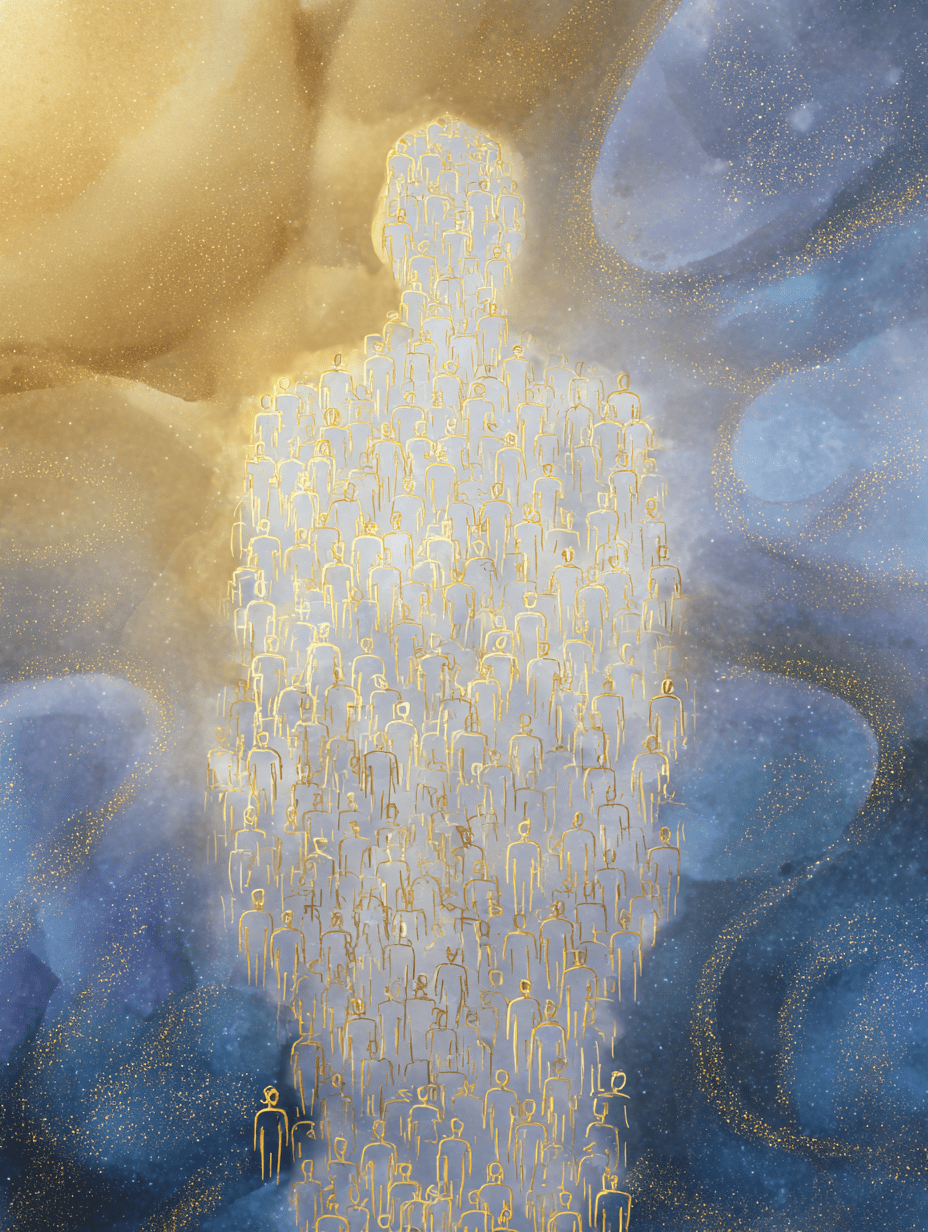

When we think of Mahatma Gandhi, an image often comes to mind: a small man in simple robes who, with the force of his will and his spirit of peace, challenged an empire. We see a leader, a politician, a symbol of freedom. But have you ever wondered, what was happening inside him? Where did he draw the incredible strength to remain calm in the face of aggression and injustice?
For me, Gandhi’s story is, above all, a tale of immense work on his own ego. It’s a story about how a true revolution doesn’t start on the streets, but in the quiet of one’s own heart.
The Ego That Wants to Fight
We all know that voice in our heads. The one that screams when we feel wronged. The one that craves retaliation, that needs to be right, that wants to assert its superiority. That is the voice of our ego. In moments of crisis, in the face of conflict, the ego naturally pulls us toward a fight—whether physical or verbal. It wants to build walls and divide the world into “us” and “them.”
Gandhi understood something fundamental: you cannot fight for peace outwardly if there is a war raging inside you. To become an instrument of peace (Ahimsa), he first had to tame his own ego. His struggle wasn’t passive; it was an active process of inner transformation.
Satyagraha – The Force of Truth, Not Muscle
His concept of Satyagraha, often translated as “truth force” or “holding firmly to truth,” is more than just a political strategy. It’s a profound spiritual practice. It required him to completely abandon his fear for his own image, his safety, and even his life.
“When the ego dies, the soul awakes.” – Mahatma Gandhi
The ego is afraid of being hurt. The soul knows it is indestructible. Through his inner work, Gandhi shifted his command center from his head (the ego) to his heart (the soul). Only from the level of the soul can you look into the eyes of an oppressor and feel not hatred, but compassion. Only from the soul can you understand that violence is a sign of weakness, not strength.
This is a lesson we need today more than ever. In our personal crises, in conflicts with loved ones, we often react from a place of a wounded “I.” Gandhi shows us another path: a path where we withdraw our energy from defending our rightness and instead focus on seeking the Truth.
Practical Applications of Satyagraha in Everyday Life
Gandhi believed that the true power of Satyagraha lies in its universality—it can be applied not only in the fight for independence but also in our daily lives. So how can we bring this philosophy into our own conflicts?
- Exercise: Reflect on a recent conflict in your life. How could you have responded differently, guided by the principle of “truth and love” rather than ego? Write down your thoughts and try to apply them in the future.
- Responding to criticism peacefully: Instead of reacting impulsively, pause and ask yourself, “Is my response coming from love or from ego?” Sometimes silence or calmly explaining your perspective can achieve far more than an emotional outburst.
- Navigating difficult conversations with empathy and respect: In moments of conflict, try to put yourself in the other person’s shoes. Instead of focusing on “winning,” look for a shared solution that brings peace to both sides.
Simplicity as a Cure for Pride
His lifestyle was no accident. Gandhi rejected luxuries, titles, and privileges. His hand-spun clothes, simple diet, and communal living were all tools to temper his ego. An important part of his daily life also included spiritual practices: meditation, prayer, and reflective journaling. It was these rituals that helped him master his own ego, maintain his composure, and lead from the heart, even in the most difficult moments. The ego loves to accumulate, to stand out, to feel “better.” Simplicity grounds us, reminding us of our equality with every other being.
Gandhi believed that simplicity was the key to inner peace because it frees us from unnecessary desires and allows us to focus on what truly matters. His daily rituals, like spinning cotton, were not just symbols of independence but also spiritual practices that kept him balanced.
For us, simplicity might mean:
- Minimalism: Reducing the excess in our lives to focus on what truly matters.
- Practicing gratitude: Taking time each day to appreciate the small things we already have, rather than constantly striving for more.
- Simplifying daily habits: Finding moments for reflection, meditation, or simply a pause in the busyness of life.
When we strip away these outer layers, what remains is what truly matters—our essence, our soul. It then becomes easier to hear that quiet voice of intuition and love, which is so often drowned out by the ego’s demands in the hustle of daily life.
The Lesson for Us Today
You might ask, “But I’m not Gandhi. I’m not fighting for a country’s independence. I have my own small, everyday problems.” And that’s precisely the point. Gandhi’s methods are universal.
Try this practical exercise inspired by his approach: Pause for a moment and ask yourself – does my reaction come from love or from fear? How can I respond to this conflict in a way that brings peace, rather than deepening the divide?
When you’re in a crisis, when you feel the world is overwhelming you and people are letting you down, try to make the same move he did. Instead of reacting with anger, pause. Look deep inside yourself.
- Is what I’m feeling just wounded pride?
- Will my reaction bring peace, or will it just escalate the conflict?
- Can I stand in my truth, even if it’s difficult?
Working on the ego is the hardest work in the world. It requires the courage to admit when you’re wrong. It demands the humility to forgive. But it is this very work that grants us true freedom. A freedom that no external system, no difficult boss, no relationship crisis can take away from us.
Mahatma – the “Great Soul” – was not born great. He became great by choosing love over fear, soul over ego, every single day. This is an invitation for all of us. We don’t have to change the entire world. It’s enough to start by changing that one small world inside ourselves. The rest will follow.
The power of these choices and Gandhi’s philosophy transcended India’s borders. His approach inspired leaders like Martin Luther King Jr. and Nelson Mandela—people who based their own struggles for freedom and equality on the values of peace, spiritual courage, and inner work on the ego. This proves that Gandhi’s teachings are universal and timeless, and that the path of inner transformation leads to real change in the world.
Gandhi as an Inspiration for Other Leaders
Gandhi’s philosophy didn’t end with his life—it became the foundation for many other leaders who fought for freedom and equality. Martin Luther King Jr. drew from the principles of Satyagraha to lead the civil rights movement in the United States. In his speeches, he often emphasized that “hate cannot drive out hate—only love can do that.”
Nelson Mandela, who spent 27 years in prison, was also inspired by Gandhi’s teachings. After the fall of apartheid in South Africa, Mandela chose reconciliation over revenge, famously saying, “Forgiveness liberates the soul.” His journey of forgiveness and humility is a powerful example of how Gandhi’s principles can transform not just individuals, but entire nations.
If you’d like to dive deeper into Mandela’s story, I’ve written about how forgiveness, humility, and spirituality conquered his ego in this article: Nelson Mandela: How Forgiveness, Humility, and Spirituality Conquered the Ego. It’s a story that beautifully complements Gandhi’s philosophy and shows how these timeless principles continue to inspire.
Gandhi showed that a leader’s true strength lies in their ability to work on themselves and inspire others to change through example, not violence.
Practical Exercise
For one week, keep a journal where you note situations in which your ego wanted to react impulsively. Reflect on how you could have responded differently, in the spirit of Satyagraha—with love and truth. At the end of the week, review your notes and look for patterns in your reactions. What changes can you make to ensure your responses align more closely with Gandhi’s philosophy?
Mahatma – the “Great Soul” – was not born great. He became great by choosing love over fear, soul over ego, every single day. This is an invitation for all of us. We don’t have to change the entire world. It’s enough to start by changing that one small world inside ourselves. The rest will follow.
If my writing has inspired or helped you, I would be grateful for your support.
Need support yourself? Discover how I can help you.
AI Disclosure
I see my thoughts as the essence, much like the soul, and AI helps me give them form. It supports me with research, translation, and organizing ideas, but every perspective is my own. Curious how I use AI? Read more here.