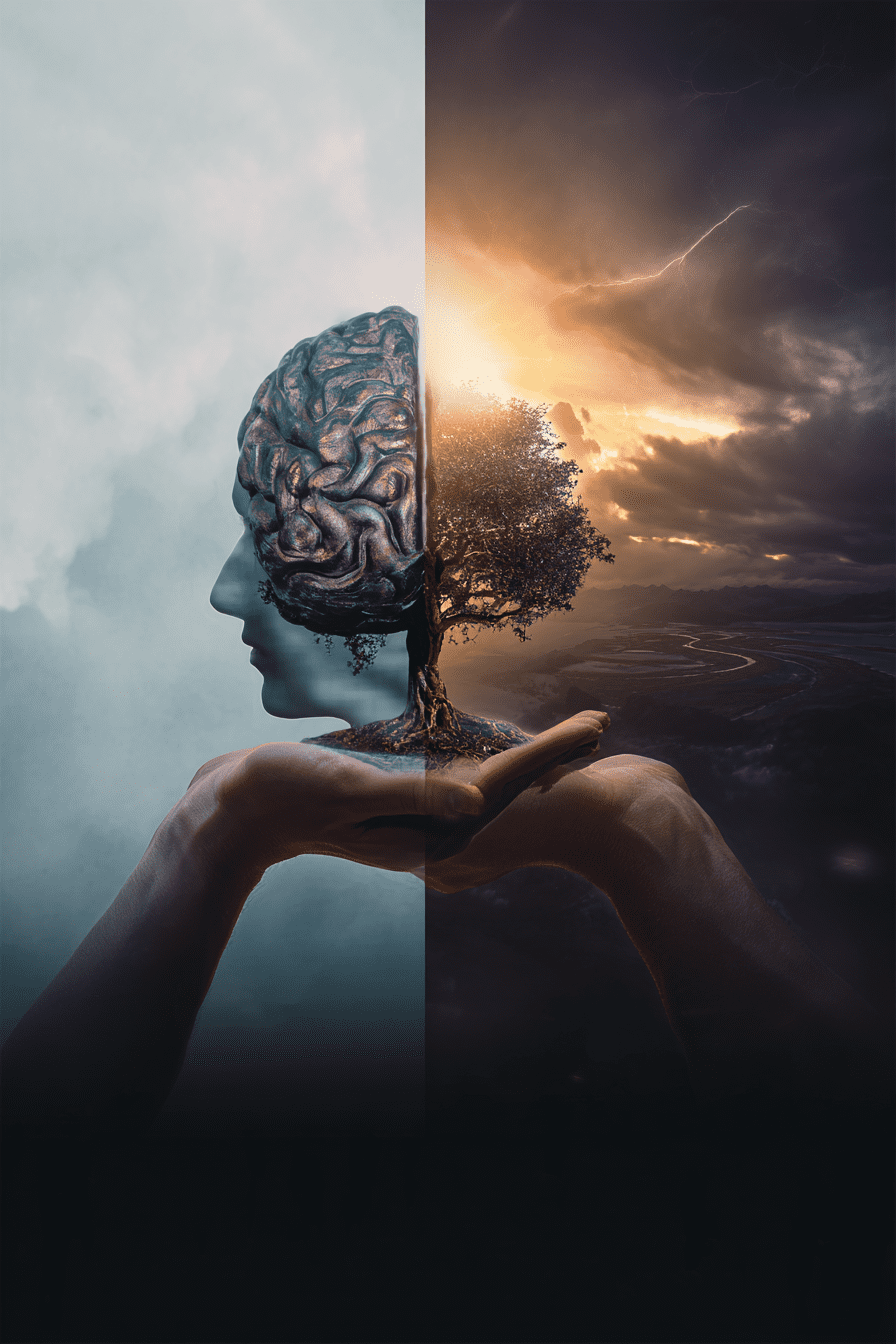
There are some questions that are hard to ignore. What does it mean to have a soul? Is consciousness just a product of the brain, or does it extend beyond biology, becoming a bridge between the body, the world, and something we might call “spirit” or the “universal realm”? For me, this is one of those mysteries that adds depth to our daily experiences, and the search for it—regardless of where it leads—provides a sense of meaning.
Seeking answers to questions about the soul, consciousness, and our place in the universe is, I believe, both a shared journey and an intimately individual one. Science, philosophy, spirituality—each of these paths offers its own maps, and I like to combine different perspectives, treating them as inspiration rather than a ready-made instruction manual for life. Ultimately, I feel that each of us is a wanderer who isn’t satisfied with just following in others’ footsteps. We want to experience this mystery for ourselves.
Modern Research on the Soul: From Neurobiology to Quantum Physics
I watch with interest how what were once philosophical considerations have become the subject of serious scientific inquiry. Neurobiology tries to capture what consciousness is by studying neural networks; quantum physics opens the door to a world where matter loses its obviousness; and philosophy never stops asking—who are we, really? What fascinates me is that no logic or laboratory has yet been able to provide definitive answers. And maybe they never will. Or maybe someday they will? Or perhaps that’s the whole point—not to know, but to never stop asking? Maybe this is how it’s designed; the physical world exists for a different purpose, to enrich the soul, not to uncover the secrets of that other world.
Or maybe consciousness is the key, and as we evolve, as our consciousness develops, we will eventually learn much more. We will discover new laws, even deeper than quantum physics, or spiritual laws beyond physics. Or we will understand quantum physics even more deeply, and it will turn out to be the answer to all questions. Or maybe one day we will understand spirituality and consciousness just as we now understand concepts like time and space. Perhaps universal values like love, respect, and empathy will become as natural and obvious to us as the laws of physics are today.
Regardless, we live here and now. I don’t believe in a single path or a ready-made formula for life. Every theory, no matter how powerful or scientific, must be confronted with my own experience and intuition. I like to experiment, and for me, searching for meaning doesn’t mean giving up the pleasures of everyday life. The constant search is just one element of spirituality. What’s most important to me is applying spiritual values in my life, and when it comes to searching, it’s about being open to change.
Consciousness as a Scientific and Philosophical Puzzle
The question of consciousness is currently one of the greatest mysteries. For me, and probably for all of you, consciousness is something more understandable and tangible than the soul. But what is consciousness, really? Does it exist outside our brain, or is it merely a result of it?
Thomas Nagel: Subjective Experience as a Challenge to Science
Thomas Nagel, a philosopher known for precisely articulating the limits of modern science, points out that consciousness carries an experience that cannot be reduced to a description of physiology or brain function. His famous essay, “What Is It Like to Be a Bat?” shows that even if we were to study a bat’s entire nervous system, we would still not know how the world is perceived from the inside—what the bat’s “self” is.
Nagel demonstrates that even the most advanced brain scanners, maps of synapses, or knowledge of neurotransmitters cannot cross the boundary of subjectivity. Materialism tries to explain everything from the ground up but collides with human experience: we cannot reduce the feeling of being ourselves to physics, atoms, or electrical discharges. Every day, even in the world of science, I touch this epistemic limit: I know there is something elusive in the experience of myself that doesn’t easily lend itself to scientific analysis.
In this sense, philosophical uncertainty is not a weakness but a value—it’s a state of openness in which one doesn’t have to decide once and for all whether consciousness is “something more” or “just biology.” It’s worth having the courage to remain in the question—because it is precisely the lack of definitive answers that awakens my curiosity and encourages further searching.
David Chalmers: The Hard Problem of Consciousness—Why Things Hurt and Delight
David Chalmers, an Australian philosopher, has for years returned to a fundamental question: why does subjectivity, the experience “from the inside,” arise? What makes it so that a human being isn’t just a collection of stimuli, an algorithm, or even a perfect computer, but can feel, dream, and fear loneliness, rather than just reacting to pain with impulses? Chalmers called this the “hard problem of consciousness”—pointing out that even if science explains all the mechanisms, from biochemistry to neural networks, it won’t find the answer to how the experience of existence arises: the feeling of pain, joy, sadness, or love.
From this uncertainty emerges one of the most interesting philosophical propositions: panpsychism. This intuition is not that every stone has a rich inner life, but that consciousness—even if minimal, proto-mental—is a fundamental feature of nature, existing at the foundation of the cosmos on par with mass or energy. Chalmers doesn’t claim this is the final solution, but he suggests that only by moving beyond reductionism can we capture the unique character of experience.
Paradoxically, this “hard problem” is a source of inspiration for me, not frustration. It’s what makes the search for meaning a spiritual act. I believe that our curiosity, our desire to ask questions, our constant digging, and our inner acceptance of the lack of simple explanations—all of this shapes my spiritual core. Even without a single, definitive answer, I know that the journey itself—the constant attempt to understand myself—gives meaning not only to philosophy or science but to everyday life.
Neurobiology and Consciousness: Does the Brain Create the Soul?
When it comes to the brain, we know much more about it than we do about consciousness or the soul. But still, it’s not much. The brain is one of the most complex and mysterious organs in our body. It is responsible for all our body’s actions, from simple tasks to thinking, emotions, and consciousness. But is it really responsible for consciousness?
Many scientific theories attempt to explain the connection between the brain and our consciousness, but many unknowns remain. Is the brain merely a biological apparatus that responds to environmental stimuli? Is it capable of creating consciousness and a soul?
Neurobiology suggests that the brain may play a key role in shaping our consciousness. Studies indicate that different areas of the brain are responsible for different aspects of our mental life, such as memory, emotions, or abstract thinking. However, some philosophical theories suggest that the brain is merely a tool for processing information, and our consciousness is something larger and independent of our body.
Therefore, debates about the brain’s role in shaping our consciousness continue. Some believe the brain is just a tool that reacts to stimuli from the external world and has no influence on who we are as people. Others, however, think the brain is a crucial element of our identity and largely determines our behaviors and thoughts.
Christof Koch and Francis Crick: Neural Correlates of Consciousness and the “Astonishing Hypothesis”
Christof Koch, along with Francis Crick, set out to track down the neural correlates of consciousness (NCC)—those specific places and pathways in the brain that give rise to subjectivity and the inner “self.” They analyzed how electrical impulses, neural networks, and complex processes in the cerebral cortex translate into what we perceive as our own thoughts, feelings, and identity. Their approach, based on precisely tracking brain activity, was intended to answer the question: where in matter can we find the source of consciousness?
In his “Astonishing Hypothesis,” Francis Crick sparked a revolution by bluntly stating that our entire conscious “self,” our thoughts, dreams, feelings of love or fear, are simply the results of biological processes in the brain. According to him, we are a collection of biochemical reactions, and the soul, if it exists at all, is merely the sum of what our nervous system can do. Many people accept this position with appreciation for science and its simplicity.
And yet, even as I learn about new discoveries in neurobiology, I still encounter a limit that science cannot cross—the limit of personal experience. I can understand the mechanics of joy or fear, but what my inner “feeling of self” truly is, no neural map can explain. Although research clarifies more and more, behind the curtain of “how,” the “why” constantly lurks—and that’s where the questions that give meaning to my search begin.
Giulio Tononi: Integrated Information Theory (IIT) and Experience as a Fusion of Everything That Makes Us
Tononi, a neurobiologist and psychiatrist by training, views consciousness as the work of a system in which information is not just a “quantity” but something qualitative. His Integrated Information Theory (IIT) proposes that the level of consciousness is determined not so much by the amount of information circulating between neurons, but by the degree to which the state of one element is inseparably linked to the states of others. Consciousness is fuller the more complex and indivisible the system is—that is, the less it can be reduced to the sum of its parts. It’s not a simple “signal” at the end of a wire, but a wave of wholeness in which everything resonates together.
Reflecting on this, I increasingly see the brain not as the source, but as the soul’s tool—a universal adapter that allows it to experience and integrate daily life into something with a deeper meaning. IIT suggests that integration and a sense of indivisible wholeness create the center of our “self.” Every experience, every joy and every pain, all the chaos and order—everything is integrated into the unique pattern of personal consciousness.
Not everything that is most important in life can be reduced to a learned pattern, a neural discharge, or a logical equation. Too many reflections I carry within me—intuitions, creative flashes that I can’t even describe in words—will not find a simple explanation in biology. Maybe the soul chooses this very world, this time, and this fate to experience and integrate something: for its journey to lead through the uniqueness of each life and the constant learning of being “here and now.”
Quantum Physics and the Soul: A Connection to Universal Consciousness
I’ve been interested in quantum physics for a long time. And it was quantum physics, thanks to Amit Goswami and his book The Physics of the Soul, that prompted me to “search for God” again—to develop my spirituality. But let’s start with someone else.
Roger Penrose and Stuart Hameroff: Orch-OR—When Consciousness Is Born on the Border of Science and Mystery
When I wonder if consciousness can be reduced to a mere collection of chemical reactions, I often return to the Orch-OR theory of Roger Penrose and Stuart Hameroff. Their approach attracts me with its courage to ask questions that go beyond established frameworks. Penrose, a mathematical visionary, does not accept the traditional, “computer-like” model of the human mind—he believes there is a place in consciousness for something unpredictable, for an authentic freedom that cannot be confined within an algorithm. Hameroff, as a physician and scientist, seeks the source of this mystery in the microtubules within neurons, where—according to their joint concept—exceptionally subtle, quantum processes occur that determine the “spark” of consciousness.
The Orch-OR (Orchestrated Objective Reduction) theory combines quantum physics with biology in an attempt to explain the nature of consciousness. According to Hameroff, microtubules act as biological “quantum computers.” It is within them, at the subatomic level, that processes like quantum superposition occur—a state in which particles can exist in multiple places at once. The key moment is the reduction of this superposition (objective reduction), which leads to the emergence of conscious experience. Hameroff believes that it is in the microtubules that the “spark” of consciousness occurs, connecting biology with the fundamental laws of physics.
Roger Penrose, on the other hand, rejects the traditional view of the mind as a deterministic “computer.” In his view, consciousness contains unpredictable elements that cannot be confined to algorithms. Penrose argues that quantum processes in the brain can explain the freedom and creativity that characterize human consciousness. He bases his claims on the theory of quantum gravity, suggesting that the reduction of quantum superposition is related to the fundamental properties of spacetime.
Orch-OR suggests that consciousness is part of a deep network of quantum connections that link us to the universe. This approach goes beyond traditional scientific frameworks, opening a space for dialogue between science and spirituality. For me personally, this unresolved nature is fascinating—where science hits the limits of understanding, infinity begins. It is in this openness that wonder and the desire to discover both myself and reality are born.
Amit Goswami: Universal Consciousness as the Basis of Reality
Now for the person who inspired me to start searching for spirituality anew. It’s not that I particularly identify with his theories, but I think about them and read them a lot. I’m talking about Amit Goswami, a quantum physicist who claims that consciousness is the basis of all reality. In his book Physics of the Soul, he describes how universal consciousness connects the soul with the mind and the physical world. Goswami suggests that consciousness is not a product of the brain, but a force that shapes reality.
His approach encourages us to look at the universe as something more than just a collection of material elements. According to Goswami, consciousness is primary—matter emerges from it, not the other way around. This perspective changes the way we perceive ourselves and our place in the world. Perhaps consciousness is the way the soul experiences reality, and quantum physics merely provides us with the tools to understand this deeper truth.
His vision of the universe, with consciousness as its foundation, made a great impression on me and encouraged me to abandon the view of God as “someone out there,” and also to look at my soul in a different way. I see a universal force that binds the soul, the mind, and the entire world. It’s not a someone, but a something—a field, a space from which what we are emerges. But I also often find myself pondering whether consciousness creates reality, or if reality builds consciousness.
Max Tegmark: Consciousness as a Mathematical Code
Max Tegmark, a theoretical physicist, proposes that consciousness may be a form of organized information. His theory connects physics and computer science, suggesting that consciousness is more fundamental than matter. Tegmark argues that understanding consciousness requires a new approach that combines science with philosophy.
According to Tegmark, consciousness is not a random product of biological processes, but the result of an incredibly complex organization of information within a system. This approach opens the door to thinking about consciousness as something that can exist in various forms, not only in the brain but potentially also in other complex systems, such as advanced artificial intelligences.
For me personally, Tegmark’s theory is an attempt to connect hard science with the spiritual intuition that in every number, structure, and even in simplicity, there is the potential to feel and be conscious. Maybe consciousness is this mathematical code that connects us to a deeper order of the universe? It seems to me, however, that spirituality eludes mathematics.
In summary, I believe that mathematics or physics can describe our reality, but when it comes to spirituality, they can only find connections, for example, through quantum processes—perhaps this is how our soul communicates with us, how it is connected to us? And our consciousness is actually a form of un-consciousness, so that we do not directly realize its existence, do not know it fully, in order to live this life and enrich it? But it seems to me that they will never be able to describe the soul itself and that other world, because no physical or mathematical laws apply there, or so I think.
Philosophy and Spirituality: The Soul as the Source of Consciousness
Is the soul the source of our consciousness? Perhaps consciousness is the software, the brain is the processor, motherboard, and other internal components, and our bodies are the case along with peripheral devices like a camera, microphone, speaker, etc.? And the soul? Maybe the soul is the real “I,” the essence that uses the body and mind as tools to experience reality, and consciousness is the interface that allows it to connect with this world.
Deepak Chopra: The Bridge Between Science and Spirituality
Deepak Chopra, a well-known author and physician, has been bridging science and spirituality for years, proposing that consciousness is the foundation of reality, not its product. In his philosophy, consciousness is not merely a function of the brain but a fundamental aspect of the universe that permeates everything that exists. Chopra argues that it is consciousness that shapes our reality, not the other way around—our thoughts, intentions, and level of awareness have a direct impact on how we perceive the world and how we function in it.
It’s worth noting that Amit Goswami, a quantum physicist and author of the “primacy of consciousness” concept, holds a similar position. Goswami also believes that consciousness is the ultimate foundation of reality, and matter is merely a product of its manifestation. He refers to quantum physics, arguing that the act of observation in the microscopic world affects the quantum state, whereby consciousness “chooses” one of the possible states of reality. This aspect of his theory connects him with Chopra, who also emphasizes the role of the conscious observer in shaping the world.
Despite these similarities, there are also significant differences in their approaches. Chopra primarily emphasizes the practical side of developing consciousness—he encourages meditation, mindfulness, and transcending the ego as ways to deepen spiritual experience. His philosophy is holistic, close to daily life and personal development. Goswami, on the other hand, focuses on creating a philosophical and scientific bridge between quantum physics and metaphysics, trying to explain the phenomenon of consciousness in the language of science and logic. In his view, consciousness becomes the fundamental field from which both the observer and the observed phenomena emerge—however, his considerations are more aimed at an audience interested in the theoretical side of the topic.
Both emphasize that science and spirituality do not have to be mutually exclusive but can complement each other, offering a deeper understanding of our place in the cosmos. Chopra does this through practice and openness to personal experience, while Goswami does it by systematically combining scientific concepts with a spiritual interpretation of existence. Their thinking inspires us to go beyond rigid frameworks and ready-made answers, encouraging us to ask questions about what consciousness really is and what role it plays in reality.
For me, Chopra’s approach remains particularly inspiring because it combines practice with a deep sensitivity to life. You don’t have to choose between spirituality and science when one can deepen the other. Both Chopra and Goswami remind us that what matters most is not just what and how we investigate, but how deeply we can feel our own existence and open ourselves to the infinity that surrounds us.
Rupert Sheldrake: The Theory of Morphogenetic Fields
Rupert Sheldrake, a British biologist and philosopher, proposed the theory of morphogenetic fields, which goes beyond the traditional understanding of consciousness and memory. According to Sheldrake, morphogenetic fields are invisible structures that organize and connect all forms of life. He suggests that memory and consciousness can exist outside the brain, in a field that is common to all beings. This field, according to his theory, stores information and experiences that can be accessible to others, creating a kind of collective memory.
Although this theory is controversial and meets with criticism from mainstream science, it inspires us to think about consciousness as something that transcends the individual. Sheldrake encourages reflection on how we are connected to other people, nature, and the universe. His work opens the door to a more holistic view of life, where consciousness is not limited to biology but is part of a larger, universal system.
For me, spirituality is not a ritual or an escape from life. It is the daily practice of mindfulness, living in accordance with my values, nurturing relationships, being ready for mistakes, and working to ensure my decisions come from a place of deep respect for myself and others. My own path is one of searching, not building houses of dogma. Spirituality, much like Sheldrake’s theory, encourages openness to questions, experimentation, and discovering one’s own truth. It is a way to understand myself and the world more deeply, to find meaning in simple actions, and to build relationships that connect us to something greater.
Near-Death Experiences (NDEs) and Out-of-Body Consciousness
Near-death experiences and out-of-body consciousness are very important to me in my search. They are highly subjective experiences that elude traditional scientific tools like physics, mathematics, or neurobiology—which is why they are so valuable and interesting. Although they are difficult to measure or explain definitively, they become particularly compelling when told by people of authority, such as scientists or doctors who have experienced them firsthand. These stories open doors to areas that science has not yet reached, and perhaps never will, and they prompt reflection on the nature of consciousness, life after death, and the limits of human knowledge. It is their subjectivity, combined with the profound impact they have on the lives of those who experience them, that makes them so fascinating and inspiring.
Eben Alexander: The Neurosurgeon Who Experienced an NDE
Eben Alexander, a neurosurgeon with many years of experience, underwent a profound transformation after his own near-death experience (NDE). In his book Proof of Heaven, he describes how, during a coma induced by severe meningitis, he experienced a reality that, he claims, existed outside of his brain. This event changed his approach to science, consciousness, and spirituality.
During his coma, Alexander described a journey to a place he called the “world beyond the world.” In his accounts, he mentions a feeling of unity with the universe, filled with infinite love and wisdom. He also spoke of encounters with spiritual beings, including a guide—a woman who led him through this spiritual dimension. The entire experience was for him full of deep peace and harmony, in a state where time and space ceased to exist, and only pure consciousness remained.
In his book, Alexander emphasizes that his experience could not have been a hallucination or a product of his brain, because his cerebral cortex—responsible for higher cognitive functions—was completely shut down at the time. He claims that what he went through was proof of the existence of consciousness independent of the body. He describes the brain as a “filter” that limits our perception of reality. After death, this filter is removed, allowing the soul to fully experience the universe.
After his experience, Alexander began to study other NDE cases and collaborate with scientists and spiritual researchers. He points out that many people who have had NDEs describe similar experiences, such as a feeling of leaving the body, passing through a tunnel towards a light, meetings with deceased loved ones or spiritual beings, and a deep sense of peace and unity with the universe. Research on NDEs shows that these experiences have a transformative effect on people—they often become more empathetic, spiritual, and less fearful of death.
His story inspires me to ask questions about the nature of consciousness, the meaning of life, and what awaits us after death. Alexander believes that death is not the end, but the beginning of a new stage—a transformation that allows the soul to continue its journey into infinity. I share this belief because I find it hard to accept that everything ends with the last heartbeat. Maybe life is just one of the stops on the soul’s path, and death is a passage to something greater that we have yet to discover.
Research on NDEs: What Do Scientists Say?
Near-death experiences (NDEs) have been studied since the 1970s, when Raymond Moody published his groundbreaking book Life After Life. Research on NDEs shows that people in a state of clinical death often describe similar experiences, such as:
- A feeling of leaving the body and observing it from the outside.
- Passing through a tunnel towards a light.
- Meetings with deceased loved ones or spiritual beings.
- A deep sense of peace and unity with the universe.
Scientists like Bruce Greyson have developed scales to assess the intensity of NDEs and have studied their impact on people’s lives. The results show that people who have had an NDE often change their approach to life, becoming more empathetic, spiritual, and less fearful of death.
Reflection: Transformation, Not the End
Stories like the one told by Alexander convince me that death doesn’t have to be a severance, but rather a transformation, a change of state—perhaps like passing through different rooms where the soul experiences something new. It’s hard for me to believe that everything ends with the last heartbeat. Maybe life is just one of the stops on the soul’s endless journey?
Research on NDEs shows that those who experience them often change: their empathy, inner peace, and sense of connection to the world increase. I also notice that the borderline moments in my life were not endings, but beginnings of a new stage. Maybe what we call death is merely a passage—a transformation that allows the soul to continue its journey.
6. Practical Implications: Why Does This Matter?
Understanding consciousness and the soul is, for me, more than just an intellectual exercise—it’s a tool that adds quality to everyday life. I feel this especially in moments when life forces me to look inside myself, to seek answers not in books, but in inner silence.
Spirituality does not disconnect us from life; it doesn’t let us forget our duties, family, or our own body. On the contrary—practiced through mindfulness, kindness, and reflection, it helps me to be present here and now, not to escape into dreams or get lost in theories.
From a psychological point of view, I understand better and better how important it is to develop my own values, make my own decisions, and have the courage to allow myself to have my own doubts. Compassion for myself and others, awareness of the fleeting nature of each day, meditative practices—all these things, though they may seem trivial, allow me to be someone who doesn’t cut himself off from the world, but tries to understand and co-create it.
The more I know about myself, the greater my readiness for empathy and for feeling a connection with other people and the world. If consciousness is something that connects us all, then my intentions, decisions, and relationships are part of a larger whole. A conscious life is not about perfection, but about constant effort and openness.
Conclusion
Modern research on consciousness and the soul teaches me to remain humble in the face of big words and theories. It connects science, philosophy, and spirituality, offering not a ready-made map, but an invitation to my own search. Perhaps the soul and consciousness are the keys to understanding our role in a vast, interconnected universe—or maybe the answer lies not in a single definition, but in the journey itself. In my life, it increasingly turns out that the journey—not the destination—provides satisfaction, a sense of meaning, and the courage to be myself.
Let each of us seek our own answer, without being afraid of not knowing. Sometimes, the greatest mystery becomes the greatest gift, leading to a life with more awareness and empathy.
If my writing has inspired or helped you, I would be grateful for your support.
Need support yourself? Discover how I can help you.
AI Disclosure
I see my thoughts as the essence, much like the soul, and AI helps me give them form. It supports me with research, translation, and organizing ideas, but every perspective is my own. Curious how I use AI? Read more here.