“Where do souls come from?” This question has fascinated humanity for thousands of years, sparking countless debates and deep reflections. Since I believe in the existence of a soul, this question is personal to me, too. I’ve often wondered what my spiritual essence is and what it wants from me in this life.
Across different cultures and civilizations, the concept of the soul remains a key to understanding life, death, and what might await us on the other side. Is it eternal? What is its purpose? And if it exists, where does it actually come from?
Religions and philosophies worldwide have tried to answer these fundamental questions. The soul has been described as the essence of life, a divine spark, and sometimes even an illusion. Some traditions see it as immortal and unchanging, while others view it as a dynamic force that evolves. Since the soul exists beyond the physical world, we can’t study it in a traditional lab. But we can look at its nature through the lens of major religions and philosophical systems that have tried for centuries to understand this mysterious part of our existence.
Where Do We Get Our Knowledge About the Soul?
The idea of the soul is deeply rooted in human spiritual and intellectual traditions. Our knowledge about it isn’t from a single source but is a mosaic of revelations, sacred texts, oral traditions, and deep philosophical analyses.
Most religions base their understanding on holy books. The Bible, the Quran, the Upanishads, and the Tanakh provide theological foundations. But long before writing, knowledge was passed down orally. Stories from shamans and elders shaped the spiritual worldview of entire communities. Mystics also played a key role—from Christian saints like Teresa of Ávila to Sufi mystics like Rumi—who described the nature of the soul through direct experiences, visions, and ecstasies.
I was raised in the Christian tradition, which shaped my initial perspective. I used to think that teachings about the soul were based exclusively on scripture. Over time, however, I realized that religions—especially in their later stages of development—drew heavily from philosophy. St. Augustine was influenced by Plato, and St. Thomas Aquinas by Aristotle. This discovery showed me just how much these traditions intertwined, collectively shaping our modern understanding of spirituality.
The Soul in World Religions: From a Gift to an Illusion
Every tradition offers a unique perspective on the origin and nature of the soul. While common themes often appear—like the soul’s role as a link to the divine—the differences can be fundamental. I approach these diverse perspectives with curiosity, trying not to lock myself into one definition.
Created as a Divine Gift (Monotheism)
In monotheistic religions—Christianity, Islam, and Judaism—the soul is seen as a unique entity created by God.
- Christianity: The Bible, in the Book of Genesis, describes the moment God breathed life into man. The soul is created at conception and is immortal.
- Islam: The Quran describes the soul (nafs or ruh) as a gift from God, though it notes that full knowledge of it belongs to Allah alone.
- Judaism: It sees the soul as a “divine spark” that returns to the Creator after death, in line with the words of Ecclesiastes: “the spirit returns to God who gave it.”
In all these traditions, the soul’s purpose is to build a relationship with the Creator, grow morally, and serve. Earthly life is a test that determines its eternal fate.
Eternal and Evolving (Hinduism)
Hinduism presents a different approach. The soul (atman) is eternal, indestructible, and inseparably linked to the Absolute (Brahman). It was not created in time but has always existed as part of the cosmic order. The Bhagavad Gita emphasizes this, stating, “The soul is neither born, nor does it ever die.” Its purpose is to learn through the cycle of birth and death (samsara) and the law of karma until it achieves moksha—final liberation.
A Stream of Consciousness Without a Fixed “Self” (Buddhism and Taoism)
Eastern traditions challenge the Western concept of individualism.
- Buddhism questions the existence of a permanent, unchanging soul, teaching the concept of anatman (no-self). Instead of a lasting entity, there is a “stream of consciousness” that passes through successive incarnations. The goal is to break the cycle of suffering by attaining Nirvana, where the illusion of a separate “self” disappears.
- Taoism describes the soul as part of the flow of life energy (qi). Death is not an end but a transformation and a return to the Tao—the primordial source of existence.
The Soul in Philosophy: Reason, Form, and Dualism
For centuries, philosophy has made analytical attempts to understand the soul, often going beyond religious dogma.
Plato argued that the soul is immortal and originates from the world of ideas—a perfect dimension to which it strives to return by knowing the truth. Interestingly, he divided the soul into three parts:
- Reason – responsible for wisdom.
- Spirit – the source of emotions and ambition.
- Appetite – related to physical needs.
His student, Aristotle, took a more pragmatic approach. In his work De Anima, he described the soul as the form that animates the body, inseparably linked to it. He distinguished between the vegetative (plants), sensory (animals), and rational (humans) souls, suggesting that only the intellectual part (nous) might possess eternal qualities.
In the modern era, René Descartes introduced his famous dualism—a radical split between the material body and the non-material soul (mind). His statement, “I think, therefore I am” (Cogito, ergo sum), emphasized that the ability to think is the ultimate proof of the soul’s existence, which he located in the pineal gland.
The Modern View: Consciousness as a Bridge
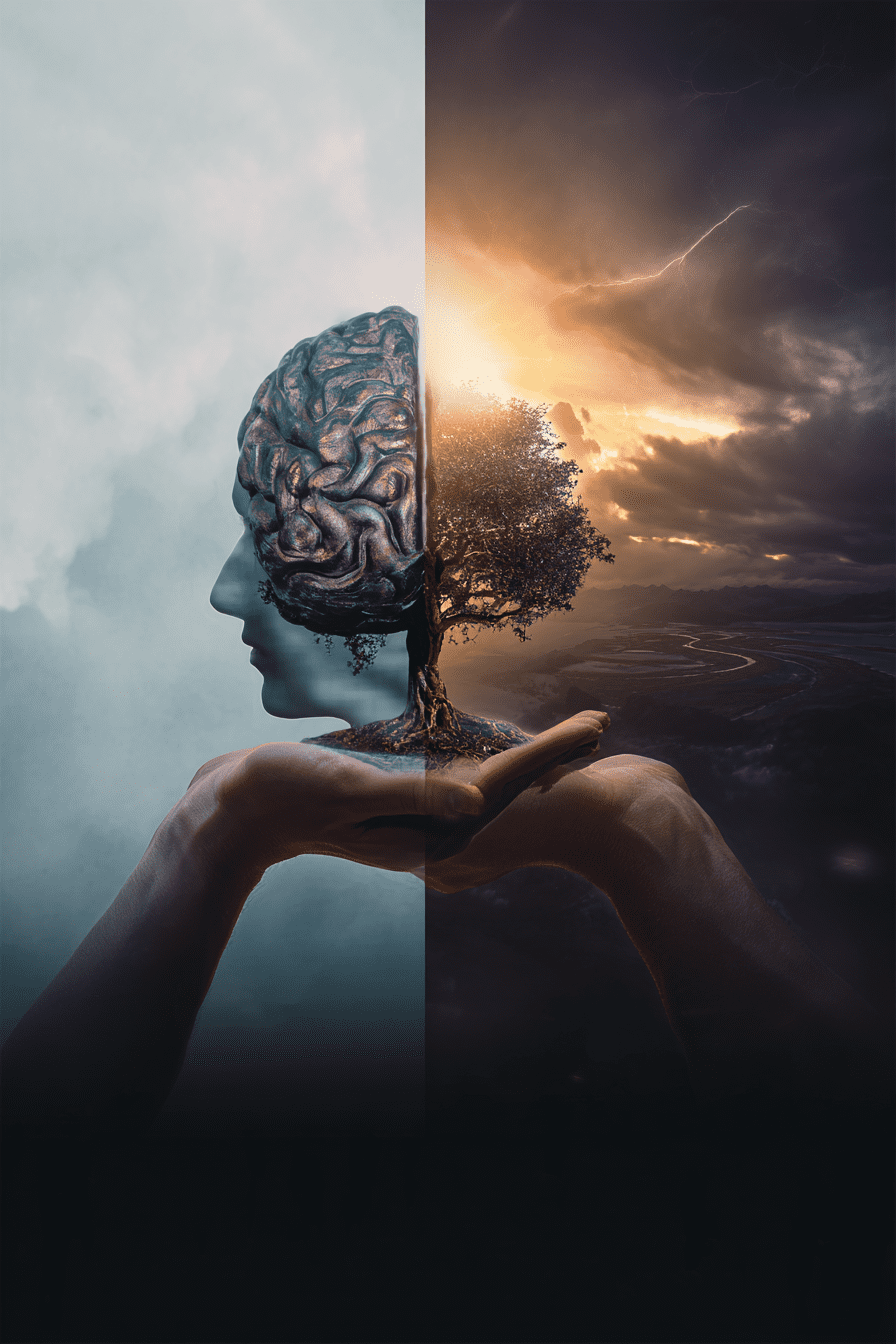
I’ve personally become fascinated with the concept of consciousness as a bridge between the soul and the physical world. Modern science and philosophy often replace the term “soul” with “consciousness,” studying its relationship with the brain.
Philosophers like Daniel Dennett challenge the existence of the soul as a separate substance, suggesting that what we call the soul is merely a product of complex neurological processes. However, other thinkers, like Thomas Nagel, emphasize that consciousness remains the “hard problem” of science. Nagel points out that subjective experience—how we feel the world from the “inside”—defies simple materialistic explanations.
Is consciousness more than just a product of neurons? Perhaps it’s a manifestation of a soul that exists beyond matter. In this view, the soul could be the source of consciousness, and consciousness itself could be the way the soul experiences and shapes reality. This topic is incredibly vast, which is why I’m dedicating a separate article to it: “The Modern Search for the Soul: Consciousness at the Crossroads of Science and Spirituality.”
Why Do Souls Exist, and Are They Immortal?
Answers to questions about purpose and immortality vary depending on the perspective, but they share a common thread: growth and transcendence.
Whether we’re talking about the Christian pursuit of salvation, the Hindu desire for liberation from karma, or the Platonic return to the world of ideas, the soul is always the element that pushes a person to transcend their limits. It is the engine for seeking deeper meaning and striving for moral excellence.
On the question of immortality:
- The religious perspective promises a continuity of existence—either in a linear form (eternal life in heaven/hell) or a cyclical one (reincarnation).
- The spiritual and energetic perspective often refers to the law of conservation of energy. Since energy is not destroyed but only changes form, the soul can be seen as an eternal essence that transforms after the body’s death, returning to the universe.
Final Thoughts
The soul remains one of humanity’s greatest mysteries. For religion, it’s the bridge that connects us to God; for philosophy, it’s the seat of reason and identity. Regardless of whether we believe in its eternal nature or treat it metaphorically, the concept of the soul helps us define our humanity.
Ultimately, for me, what matters more in spirituality is how I live out my values rather than precisely defining what my soul is. But the act of asking these questions is valuable in itself. Perhaps the final answer doesn’t lie in one specific definition, but in the search itself—a search that inspires us to live with greater awareness and empathy.
What are your thoughts?
Do you see the soul as an eternal spark, or perhaps as a product of the human mind? Share your thoughts in the comments.
If my writing has inspired or helped you, I would be grateful for your support.
Need support yourself? Discover how I can help you.
AI Disclosure
I see my thoughts as the essence, much like the soul, and AI helps me give them form. It supports me with research, translation, and organizing ideas, but every perspective is my own. Curious how I use AI? Read more here.