Theo lived his life in a series of strategic evasions. He was a master of the invisible arts—wearing oversized hoodies in the sweltering heat, sitting in the back corners of cafés, and walking with his eyes fixed firmly on the pavement. He carried his body like a burden he wished he could set down.
To the world, he was just a guy walking down the street. To Theo, he was a walking catalogue of flaws: hair the color of a rusty penny that refused to be tamed, a waistline that spilled over his belt, and a face he was convinced only a mother could love—and even she often suggested he “try a new haircut.” He didn’t just dislike his reflection; he was at war with it.
Shame was his shadow. It whispered to him that he took up too much space, that his presence was an inconvenience, that he was simply wrong. So, he made himself small inside, even if he couldn’t on the outside.
The Invisible Man in the Park
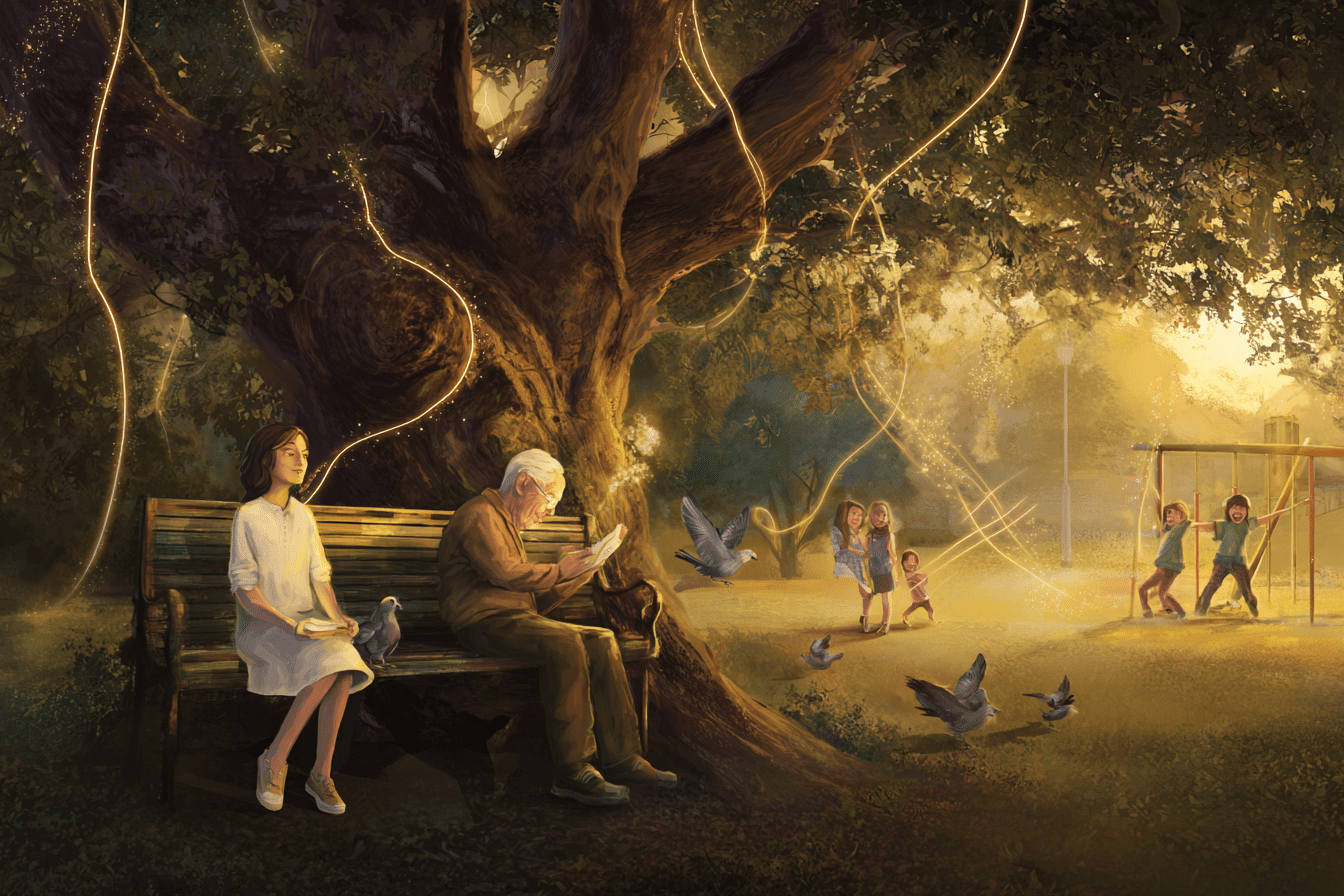
One crisp autumn afternoon, Theo found himself in the city park. It was his sanctuary, a place where he could sit on a bench and watch the golden leaves drift down, pretending for a moment that he was just a spectator in life, not a participant who was failing the audition.
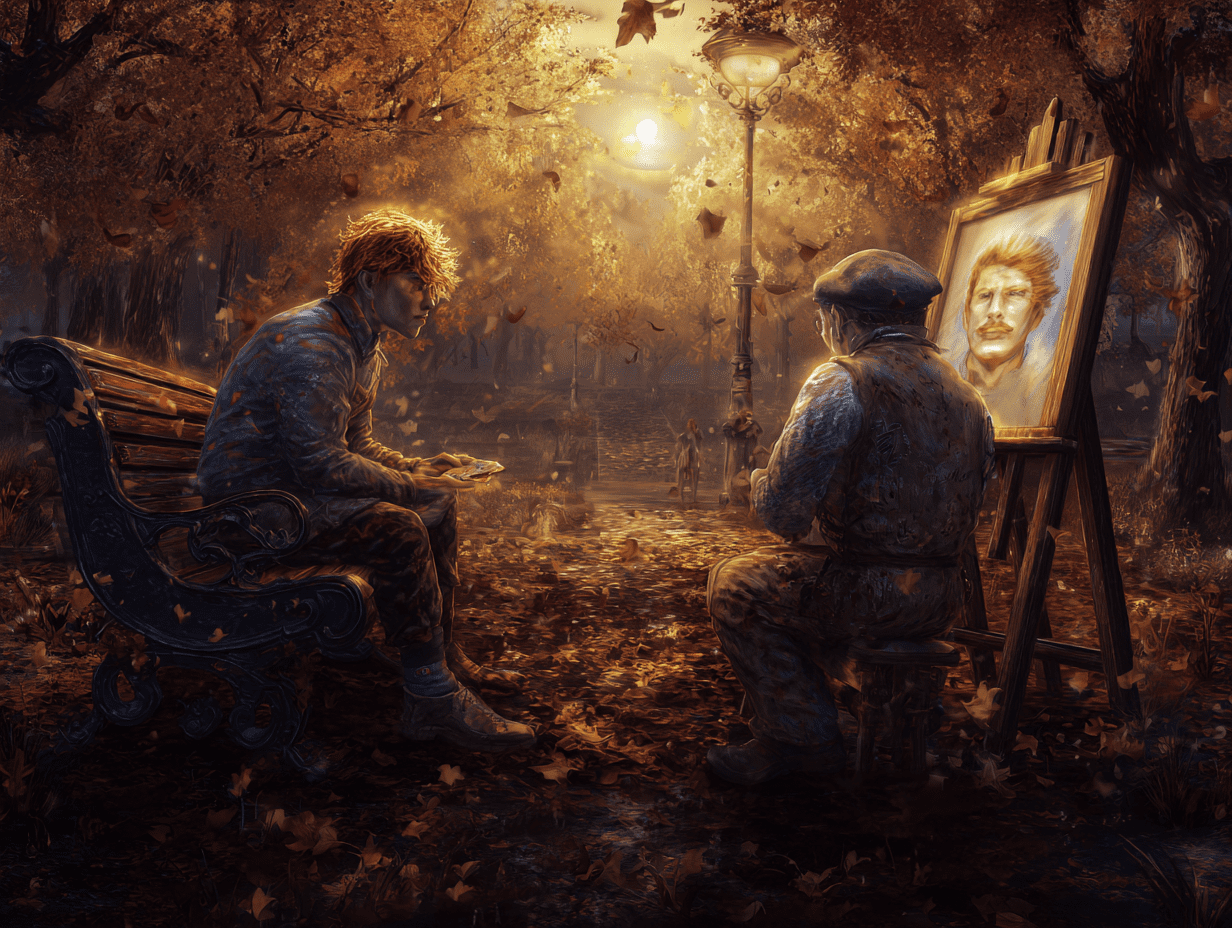
He sat near the duck pond, hunched over a book he wasn’t really reading. Not far away, an elderly man had set up an easel. He was a chaotic splash of paint himself—smudges of blue on his nose, a beret that had seen better decades, and hands that moved with a frantic, joyful energy.
Theo watched him covertly. The painter seemed to be capturing the landscape, the light hitting the water. Theo felt safe. The painter was looking at the ducks, not the heavy, red-haired man on the bench.
Suddenly, the painter stopped. He turned slowly, his eyes narrowing behind thick glasses, and looked straight at Theo. Theo froze. His instinct was to flee, to gather his oversized hoodie around him and disappear.
“You,” the painter called out, his voice cracking with excitement. “Don’t move. The light… it’s perfect right there.”
A Canvas for the Unseen
Theo looked around, sure the man was talking to someone else—perhaps a jogger with a sculpted physique or a couple in love. But there was no one else.
“Me?” Theo squeaked, his face burning a shade that clashed violently with his hair.
“Yes, you! Come, come sit. I must paint you,” the old man insisted, waving a brush like a conductor’s baton.
Panic rose in Theo’s chest. “No, I… I’m not a model. You don’t want to paint me. I’m… I’m just…” He trailed off, unable to say the words out loud. I’m ugly. I’m fat. I’m wrong.
The painter laughed, a sound like dry leaves rustling. “You are not ‘just’ anything. You are a landscape of texture and color! That hair—it catches the sun like fire. And the sorrow in your posture… it has gravity. It has truth. Please. Humor an old man.”
Against every screaming instinct, Theo didn’t run. Perhaps it was the kindness in the man’s eyes, or perhaps he was just tired of running. He sat.
The Mirror of Art
For an hour, Theo sat still, feeling exposed and vulnerable. He imagined what the canvas looked like—a caricature, a mockery of his double chin and his flushed cheeks. He braced himself for the humiliation.
“Done!” the painter announced with a flourish.
Theo walked over slowly, his heart hammering against his ribs. He prepared his polite, self-deprecating smile. He looked at the canvas.
The breath left his lungs.
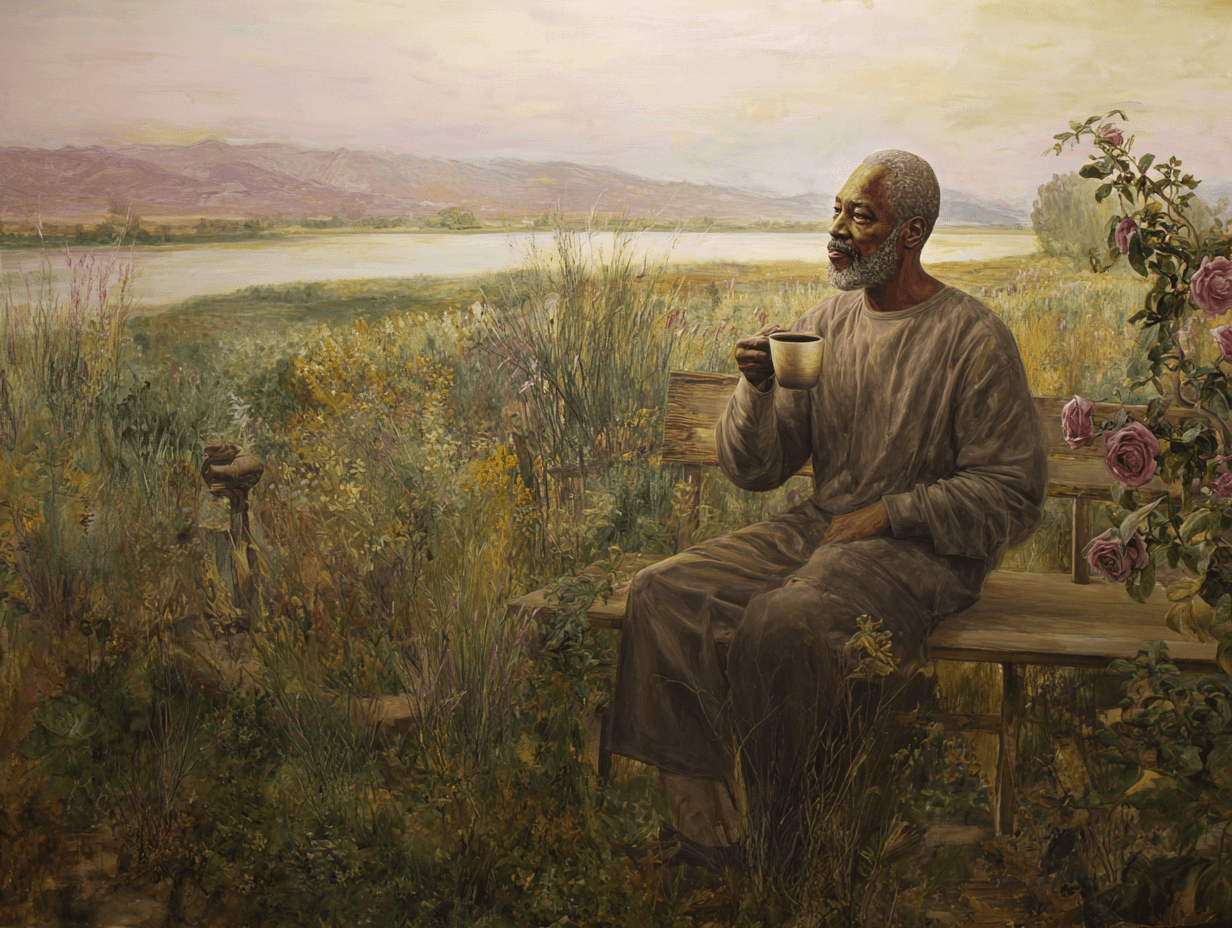
It wasn’t a photograph. It didn’t hide his weight or change his hair color. But the man on the canvas wasn’t ugly. He was… magnificent. The painter had captured the way the sunlight turned his hair into a halo of copper and gold. He had painted Theo’s heaviness not as fat, but as solidity, a grounding presence like an ancient oak tree. The eyes on the canvas held a gentle melancholy that looked deep and soulful, not pathetic.
It was him. But it was him seen through eyes that looked for beauty, not flaws.
“You see?” the painter said softly, standing beside him. “The world tells you to fit into a box. But you? You are a mountain. You are a sunset. You have color and weight and presence. Why would you want to be a blank sheet of paper when you can be a masterpiece?”
A Shift in Perspective
Theo stared at the painting. For the first time in his life, he didn’t feel the urge to apologize for existing. The shame that had been his constant companion loosened its grip, just a fraction.
He realized that he had been looking at himself through a lens of judgment, comparing himself to impossible standards. But this stranger saw him as art. And art doesn’t have to be perfect to be beautiful; it just has to be true.
He walked home that day differently. He didn’t pull his hood up. He let the wind mess up his unruly red hair. He walked with the weight of a mountain, solid and real. He wasn’t fixed—years of self-loathing don’t vanish in an hour—but the crack in the wall had appeared. The light was getting in.
Reflection
And now, a question for you…
What do you make of Theo’s transformation? Was the beauty really in the painting, or was it always there, waiting for him to acknowledge it?
Perhaps Theo’s story is a reminder that we are often our own harshest critics. We look in the mirror and see a checklist of failures, while others might look at us and see warmth, resilience, and unique character. The painter didn’t change Theo; he simply offered him a different mirror.
Have you ever struggled to accept a part of yourself that didn’t fit the “norm”? What would happen if you looked at yourself today not as a problem to be solved, but as a portrait to be appreciated? Share your thoughts in the comments below.
If my writing has inspired or helped you, I would be grateful for your support.
Need support yourself? Discover how I can help you.
AI Disclosure
I see my thoughts as the essence, much like the soul, and AI helps me give them form. It supports me with research, translation, and organizing ideas, but every perspective is my own. Curious how I use AI? Read more here.