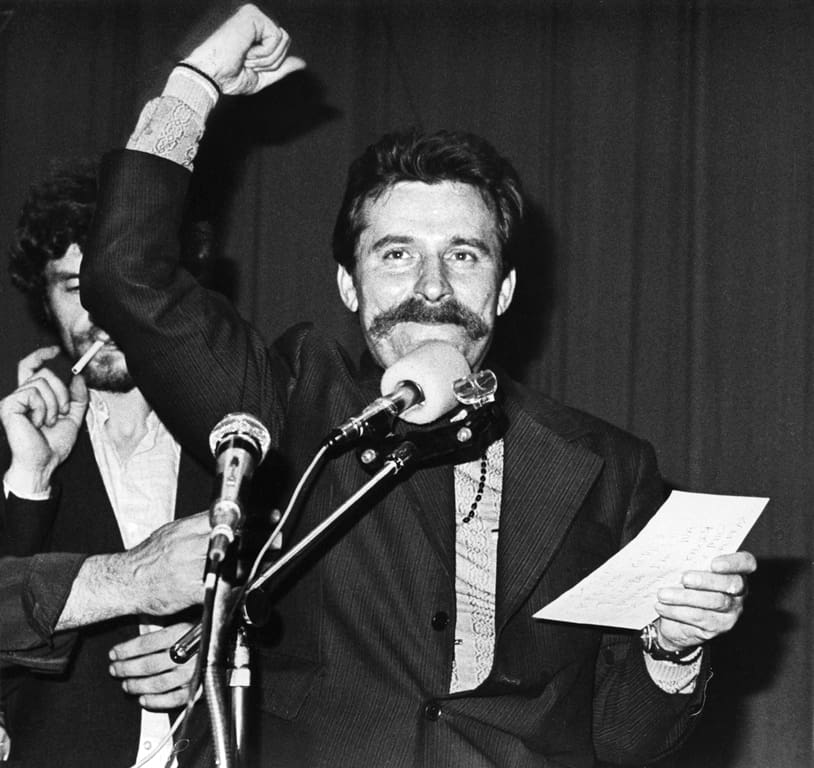
Lech Walesa (Lech Wałęsa) stands as a global symbol of the struggle for freedom and democracy. Best known for leading the Solidarity movement—a peaceful revolution that changed the course of history in Poland and beyond—Walesa proved that even one “ordinary” life can unleash extraordinary change. Much like Gandhi or Malala, he showed that courage, values, and spiritual conviction can inspire millions.
The collapse of communism in Central and Eastern Europe and the weakening of the Iron Curtain had their roots in those moments when Walesa, rosary in hand, demonstrated that fidelity to values and spiritual resilience could inspire the world to change. But behind the political leader was a deeply faithful man, drawing strength from spirituality and moral principles.
From his youth, he often said that “without God and faith, I wouldn’t have even jumped over a fence.” When the time came to fight a powerful system, he frequently invoked the message: “There is no freedom without solidarity.” These words became more than his motto; they were the heartbeat of a movement that swept up millions of Poles. Walesa himself emphasized that it was faith, hope, and community that gave him the courage to stand against oppression.
It was no accident that Gospel quotes appeared on shipyard walls and among protesters, alongside Pope John Paul II’s famous call: “Be not afraid!”—words powerful enough to awaken hope even in the darkest times. In moments of uncertainty, when the future seemed bleak, Walesa often pointed to faith as his anchor. Prayer, hope, and the conviction that good would ultimately triumph allowed him to survive the toughest moments. His story is not just about political bravery, but about the spiritual stamina that inspired millions around the globe.
In this article, we’ll look at how Lech Walesa’s spirituality shaped his life and decisions. We’ll explore how Christian values formed the backbone of the Solidarity movement and how a unique bond with Pope John Paul II became a pillar of his resilience. This is a story about how faith and morality can be the engine for changing the world—and how every one of us can draw inspiration from it.
Historical and Spiritual Background
Before Lech Walesa became the face of Solidarity and a catalyst for sweeping change in Europe, he was just a boy from Popowo, born in 1943 during a time of war and hardship. Raised in a hardworking, traditional Catholic family, he absorbed values like righteousness, honor, and deep respect for human dignity—lessons learned not in lecture halls, but in the everyday struggles of post-war Poland. This humble foundation anchored him for the battles ahead, shaping both his spirituality and his fearless leadership.
As a young boy, faith was a natural part of his daily life—an element of his home’s atmosphere, traditions, and shared holiday celebrations. Over time, when confronted with the challenges of adulthood, the brutality of heavy industry, and a soulless political system, his spirituality matured, taking on a more personal and conscious dimension.
Initially, Walesa’s religiosity was simple and intuitive, anchored in folk piety. However, as he experienced successive crises, persecution, and the weight of lonely decisions, his faith deepened. It ceased to be an unreflective tradition and became a dialogue with God, a source of courage, and a place where he sought answers to fundamental questions.
During the lonely nights of internment, prayer took on a completely new meaning for him: it became a conversation, a fight for hope, and a form of spiritual resistance against violence and helplessness.
With time, Walesa transformed his spirituality into a conscious tool for building community and leadership. He discovered that his fight wasn’t purely political; it had an existential dimension. As he said himself: “I wouldn’t have carried this without God.” Faith gave him a sense of purpose, allowing him to look beyond his own fate toward the common good. Like Gandhi or Martin Luther King Jr., he didn’t cut himself off from doubt or moments of weakness; instead, he found authenticity within them.
This evolution—from inherited faith to a conscious choice born of pain, loneliness, and hope—is what makes Walesa’s spirituality so authentic and inspiring. His journey shows that spiritual strength isn’t static; it grows with us, develops through trials, and becomes a foundation for changing the world—even if the path leads through the darkest valleys.
For young Lech, faith wasn’t just a Sunday ritual or a set of dry dogmas. It was the air his home breathed. Raised in a traditional Catholic spirit, he absorbed values that were crucial for his nation’s identity at the time: righteousness, honor, and a deep respect for human dignity. It wasn’t university lecture halls, but this simple, “folk” piety that became his most important school of life.
Walesa’s later leadership style—so direct, sometimes rough, but always authentic—grew from this very spiritual soil. He never tried to be a theologian or a philosopher. His moral compass was set very simply: distinguishing right from wrong, truth from lies. This clarity, rooted in the Gospel, gave him the courage to stand up to a powerful totalitarian system without a shadow of fear.
Faith as a Source of Strength
The most defining battles Walesa fought weren’t in front of crowds or cameras, but in isolation—alone in a prison cell, cut off from family, and pressured to give up. In those moments, faith became his lifeline. Prayer was his daily ritual, giving him peace and clarity when everything else tried to break him. His unshakable conviction—rooted in a deep relationship with God—empowered him to resist compromise, find hope amidst suffering, and hold on to truth even when the world seemed against him.
His internment in Arłamów was one of his hardest trials. Cut off from his family and the world, subjected to constant attempts to break his character, he could have easily given in. The regime had all the tools: fear, blackmail, isolation. Walesa had a rosary. This isn’t a metaphor. Witnesses and Walesa himself recall that prayer was his daily rhythm, a way to keep his mind clear in a reality designed to destroy him psychologically.
In this intimate relationship with God, he found the strength to say “no” when reason suggested compromise. His stubbornness didn’t come from pride or political calculation, but from a deep, internal conviction that truth is non-negotiable. Faith gave him a perspective that went beyond the “here and now,” allowing him to see meaning in suffering and hope where others saw only a wall.
Religious Symbolism in Solidarity
Memories of August 1980 aren’t just of banners with wage demands—but above all, of images that forever changed the iconography of rebellion: the Gdańsk Shipyard gate, hung with flowers and portraits of the Virgin Mary and Pope John Paul II. This was no accident or mere decoration. For Walesa and thousands of striking workers, the presence of religious symbols was a clear signal: this isn’t just a fight for bread; it’s a fight for dignity and for the soul of the nation.
Bringing religious symbolism into the very heart of the strike was an act of rebellion against the materialism of the communist system. Masses celebrated on factory grounds, confessions in shipyard halls, workers kneeling on concrete—all of this created an extraordinary atmosphere of community that transcended politics.
A Bond with John Paul II
The relationship between Walesa and John Paul II was much more than just meetings between two influential Poles. It was a spiritual alliance, a quiet understanding of souls connected by a shared vision of a free and dignified human being.
For Walesa, the election of Karol Wojtyła as Pope in 1978 was a turning point—a spark that lit the fuse of hope. The words “Be not afraid!” became a spiritual command that guided him during the shipyard strikes. The Pope didn’t need to issue political instructions; he gave something more important—moral backing and the certainty that the fight for truth made sense.
Lessons for Today
Lech Walesa’s story reminds us that leadership doesn’t start with titles and positions, but with internal integrity and the courage to stay true to your convictions—even at the cost of personal sacrifice. His life shows that faith and spirituality aren’t escapes from reality, but forces that give meaning to hardship, fuel resilience, and empower authentic change.
So what can we take from his journey into our own lives?
- Lead with Integrity: Whether you’re at work or in your community, let your actions be guided by what you truly believe is right. Don’t be afraid to take an unpopular stand if it means protecting dignity or justice.
- Build Community: Walesa’s success wasn’t his alone; it was fueled by the power of “Solidarity.” At work, cultivate trust and mutual support with colleagues. In your neighborhood or online circles, foster inclusivity and a shared purpose.
- Practice Courage and Perseverance: When facing challenges or setbacks, remember that courage isn’t the absence of fear—it’s choosing to act despite it. Like Walesa, draw strength from your convictions and spiritual roots.
- Turn to Reflection and Faith: Make time for self-reflection, whether through meditation, prayer, or mindful walks. This inner grounding can help you find direction during uncertain times.
- Act for the Common Good: Don’t seek change just for personal gain—look beyond yourself and ask how your energy or leadership can benefit others, especially those whose voices aren’t always heard.
No matter where you lead—in the boardroom, a classroom, or your own home—Walesa’s path shows us the impact of standing for principles, supporting one another, and letting faith in something greater propel you forward. Let his example inspire courageous leadership and meaningful action in your everyday life.
His example is a call to seek strength beyond our own ego—in faith, prayer, and reflection—and to build solidarity in community, not in solitude. Walesa’s path teaches that even one person, rooted in values and faith, can move the world. True strength is not born of power, but of an unbreakable spirit.
What are your thoughts on Lech Walesa’s story and its lessons? Share your reflections or questions in the comments below!
If my writing has inspired or helped you, I would be grateful for your support.
Need support yourself? Discover how I can help you.
AI Disclosure
I see my thoughts as the essence, much like the soul, and AI helps me give them form. It supports me with research, translation, and organizing ideas, but every perspective is my own. Curious how I use AI? Read more here.